
What Kind of Thing Is an Alien Mind?
Reading Jakub Pachocki on intelligence, agency, alignment, opacity, and recursive self-improvement
Mistral Large 4, released as a public API preview on 6 October 2026, marks a significant development in European foundation-model production. Its approximate trillion-parameter sparse architecture, training on Mistral-operated European infrastructure, and strong results on selected agentic and cybersecurity evaluations establish substantial industrial capability. They do not establish parity with the strongest contemporary American systems, superior training efficiency, or independence from the global semiconductor and software supply chains.
This article compares Mistral with American proprietary and open-weight models and with China’s increasingly competitive open-weight ecosystem. It examines the popular claim that Mistral has reached the capability OpenAI offered seven months earlier, distinguishing historical release dates from consistently measured capability. Artificial Analysis supports a qualified comparison with a retrospectively estimated March 2026 model; Epoch AI places Mistral Large 4 in the performance range reached by OpenAI’s o3 in April 2025 and by an open-weight Chinese model in January 2026. These are different benchmark-specific historical analogies, not a single measurable technological delay.
Extending the layered framework used in How Sovereign Is Kolibri?, the article separates control of model development, training information, compute, hardware, software, deployment rights, reproducibility, and corporate governance. Its conclusion is that Mistral meaningfully improves Europe’s ability to produce AI models and, through earlier released weights, its ability to retain them. Yet technological autonomy depends less on any one model’s leaderboard position than on whether European institutions can deploy adequate capabilities, substitute critical suppliers, and sustain subsequent model generations.
An evidence-based comparison of Mistral with American and Chinese foundation models, and an assessment of what model capability contributes to European digital sovereignty.
Mistral AI introduced Mistral Large 4 on 6 October 2026 as a public API preview of its largest foundation model. The company describes a natively multimodal sparse Mixture-of-Experts (MoE) architecture with approximately one trillion parameters, 52 billion of them active, trained from scratch on 3,800 NVIDIA Grace Blackwell GPUs in its own European datacentres. Artificial Analysis independently measured an Intelligence Index score of 38 and identified it as the strongest evaluated model originating outside the United States and China. The model is a substantial European industrial achievement, although its weights were still scheduled for publication later in October rather than publicly available on the 18 October research cutoff.12
The release invites two claims that require different kinds of evidence. One is comparative: Mistral has reportedly reached the performance level OpenAI offered in March 2026, roughly seven months before Large 4. The other is strategic: achieving such performance with fewer resources strengthens European digital sovereignty. Even if the first claim is approximately correct on a particular benchmark, it does not by itself establish the second. Benchmark performance, training efficiency, deployment independence, and sovereignty over the underlying production system are distinct properties. A European model can perform competitively while depending on foreign accelerators and software; a Chinese model can have foreign provenance yet be operated independently on European infrastructure when its weights and license permit it.
The earlier article, How Sovereign Is Kolibri?, established a useful starting point: model sovereignty should be assessed through demonstrable controls, not inferred from the nationality of the company making the announcement. Kolibri’s documented Model Factory provides strong evidence of European control over development and deployment, even though the system uses NVIDIA accelerators and external teacher models and is not fully reproducible from public artifacts. Mistral raises the stakes by adding a larger commercial model portfolio, substantial capital investment, and European-operated frontier-scale compute. Whether that makes Europe meaningfully more autonomous depends on the capabilities it can preserve when a supplier, service, license, or corporate relationship changes.3
The argument developed here distinguishes three goals. Capability sovereignty concerns access to models good enough for strategically important tasks. Deployment sovereignty concerns the right and ability to retain, configure, and run those models independently of the original provider. Reproductive sovereignty concerns Europe’s capacity to develop successor models when existing checkpoints are no longer sufficient. They are related but not equivalent. A commercial API may provide access to a required capability without ensuring its continued availability; suitable open-weight releases and controlled inference infrastructure can establish a degree of deployment independence; and the ability to develop successor models requires sustained research expertise, training information, compute resources, and model-production organizations.
The analysis uses information available through 18 October 2026. Vendor specifications and announced infrastructure are identified as claims or plans where independent validation is absent; scores and prices are attributed to their named evaluation systems rather than presented as properties of intelligence itself. The first task is to understand what Large 4 actually changes, before testing the historical performance claim against both American and Chinese alternatives.
Mistral’s development cannot be reduced to the increase from billions to trillions of parameters. Mixtral 8×7B, released in December 2023, established its early emphasis on sparse architectures: its router activated two feed-forward experts per token, limiting the arithmetic performed relative to the full parameter population. Mistral Large 3, released in December 2025, extended this approach to 675 billion total and 41 billion active parameters, while the accompanying Ministral 3 family supplied smaller dense models for constrained deployment. Large 3’s base and instruction checkpoints were distributed under Apache 2.0, making that generation independently retainable and deployable.4
The March 2026 release of Mistral Small 4 combined instruction following, reasoning, and agentic coding in a model with approximately 119 billion total and 6 billion active expert parameters per token, with a longer context and downloadable weights. Mistral Medium 3.5, by contrast, pursued a dense architecture oriented toward demanding coding and tool-use workflows. These releases illustrate a deliberate portfolio rather than a single scaling trajectory: sparse models seek useful capability at manageable active computation, while dense and smaller models address execution simplicity, deployment constraints, and particular classes of tasks.56
Large 4 represents a further increase in both model scale and the sophistication of post-training. Mistral reports approximately 52 billion active parameters, although Artificial Analysis records 49 billion, an unresolved difference that may reflect accounting conventions or documentation revisions. The model accepts text and images and produces text. The independently evaluated preview exposes a 512,000-token context window, which should not be silently equated with larger limits that may be advertised for other configurations. A claim that training involved more than 160 languages establishes multilingual coverage in the corpus, not uniform quality across all those languages or tasks.7
The more consequential change may be organizational. Mistral’s release describes a reinforcement-learning system in which heterogeneous environments for coding, scientific work, tool use, security, and factuality share mechanisms for generating trajectories, verifying outcomes, and updating the model. At a reported scale of roughly 3,000 GPUs, its rollout system produces approximately 33 billion tokens daily, of which 16 billion remain trainable after filtering and masking. These figures support the existence of a serious post-training operation; they are not a disclosure of total pre-training FLOPs, the duration of development, or cumulative model-production costs.8
Early evaluations show important but uneven gains. Artificial Analysis scores the preview at 38 on its Intelligence Index and 50 on its Cyber Index. Its GDP.pdf result rises to 19%, an 18-percentage-point improvement over Large 3, but the evaluator attributes part of that gain to a change in the API’s image allowance from eight to one hundred images per request. Mistral separately reports 61.7% on DeepSWE v1.1, 28.3% on Terminal-Bench 4.0, and 59.9% on AutomationBench, among other evaluations. Those vendor results help identify workloads emphasized during development; they should not be merged uncritically with independently measured scores or interpreted as evidence of global superiority across all tasks.910
There is also a distinction between a model’s planned distribution and its present status. At the cutoff, customers can download and deploy the earlier Apache-licensed Large 3 and Small 4 checkpoints, whereas Large 4 remains a research preview accessed through Mistral’s service. The announced plan to release Large 4’s weights later in October is relevant to its prospective sovereignty value, but it is not a substitute for published weights, final license terms, and independent serving benchmarks. What the release already establishes is the ability of a European company to produce successive complex models; what it does not yet transfer is independent control of this particular new checkpoint.
OpenAI released GPT-5.4 on 5 March 2026. Artificial Analysis’s October catalogue assigns the xhigh reasoning configuration an Intelligence Index score of approximately 39, beside Large 4’s independently measured 38. Read as a retrospective, approximate performance-band comparison, this makes the seven-month statement plausible. However, the GPT-5.4 figure is explicitly estimated, not the result of a complete contemporaneous evaluation under the exact same October procedure. Nor does it cover GPT-5.4 Pro or every aspect of the capabilities available from OpenAI in March.1112
A second error would be to compare Large 4’s October score with numerical scores published for GPT-5.4 near its original release. Artificial Analysis revised its Intelligence Index repeatedly during 2026. By 18 October 2026, the Intelligence Index had reached version 4.3.2, incorporating ten evaluations: AA-Briefcase v1.1, GDPval-AA v2.1, AutomationBench-AA, Terminal-Bench 4.0, SciCode, Humanity’s Last Exam, GDP.pdf, CritPt, AA-Omniscience, and AA-LCR v1.1. The weighting is 30% agentic tasks, 20% coding, 30% general capabilities, and 20% scientific reasoning. A score obtained under an earlier evaluation suite is not on an invariant scale with October’s result; the difference between two such scores cannot be read as an improvement or deterioration in intelligence.13
The comparison must distinguish two clocks. Calendar time identifies when a model entered the market; measurement time identifies when and how its capabilities were evaluated. A sound retrospective historical analogy uses one evaluation methodology for both the present model and an earlier comparator, reports whether results were measured or estimated, and treats uncertainty as part of the conclusion. It should not assume a universal relationship between elapsed time and progress across tasks.
Epoch assigns Large 4 an ECI score of 147 and approximately 147 to OpenAI’s o3, released on 16 April 2025. Epoch’s o3 profile identifies a low-reasoning-effort evaluation, so the comparison establishes similarity between recorded capability estimates rather than equivalence under matched inference-time compute budgets. The elapsed period between these two releases is nearly eighteen months, not seven. This is a documented example of an earlier American proprietary model occupying the same ECI performance band; without exhaustive first-crossing analysis and confidence-interval testing, it is not proof that o3 was the first proprietary model ever to reach that band.1415
A comparable Chinese open-weight example also predates Large 4 by months. Epoch assigns 148 ECI to Moonshot’s Kimi K2.5, released on 27 January 2026, and 156 to Z.ai’s GLM-5.3, released on 14 August 2026. The former was already in approximately Large 4’s ECI band about eight months earlier; the latter was above it by the October cutoff. These comparisons use a different index from Artificial Analysis, and neither should be represented as the precise date when all Chinese open-weight systems first achieved equivalent capability.1617
The different historical analogies are summarized in Table 1. They are not intended to be averaged: the disagreement is analytically important because it exposes the benchmark dependence of the claim.
| Measurement and comparator | Large 4 score | Historical model and score | Historical release | Elapsed interval | Qualification |
|---|---|---|---|---|---|
| Artificial Analysis, October methodology | 38 | GPT-5.4 xhigh, 39 estimated | 5 Mar 2026 | ~7 months | Approximate, incompletely measured comparison |
| Epoch ECI, US proprietary | 147 | OpenAI o3, ~147 | 16 Apr 2025 | ~18 months | One matching historical example, not an earliest-crossing proof |
| Epoch ECI, Chinese open weights | 147 | Kimi K2.5, ~148 | 27 Jan 2026 | ~8 months | Similar rounded ECI band, not verified statistical equivalence |
| Epoch ECI, later Chinese open weights | 147 | GLM-5.3, ~156 | 14 Aug 2026 | — | Chinese comparator already scores higher |
The two indices differ in benchmark composition, modelling assumptions, and sensitivity to particular abilities. Epoch itself estimates uncertainty in ECI and, in a May 2026 analysis, found that the strongest open-weight models collectively lagged the closed-weight frontier by around four months on average during the first months of the year; requiring strict point-estimate superiority increased that estimate to roughly six months. This describes the best open-weight ecosystem as a whole, not Mistral’s individual lag. Epoch also reported in October that the leading open-weight cybersecurity model lagged the proprietary cyber frontier by six to seven months on a different, domain-specific index. Neither statistic may legitimately be substituted for Large 4’s general-purpose historical position.1819
Composite scores also conceal important differences. Large 4 can be strong in particular agentic work, coding, or cyber evaluations yet remain weaker on difficult scientific questions and knowledge reliability. Its results depend on tool permissions, reasoning effort, API behavior, model snapshots, and the evaluation harness. A one-point difference in a weighted index has no stable interpretation as a percentage of intelligence or a fixed delay in months. A defensible estimate would require the complete archived set of release dates, scores under a common versioned benchmark, model-level uncertainty, and an explicit definition of statistical equivalence. The available evidence supports useful historical comparisons, not an exact scalar technology lag.
Mistral Large 4 is not at the contemporary global frontier of measured aggregate capability. On Artificial Analysis’s October methodology, Claude Opus 5.5 scores 58 and GPT-6 Astra 53, substantially ahead of Large 4’s 38. Yet this aggregate gap does not establish uniform inferiority across economically or strategically relevant tasks. Large 4 reaches 50 on the independently evaluated Cyber Index and 82% on CyberGym-E2E-AA, while third-party financial-research and legal-agent evaluations show competitive results against selected proprietary models. These outcomes concern different capabilities, benchmark populations, and evaluation procedures; they neither erase the general-purpose performance gap nor establish overall frontier parity. Their significance lies in showing that the practical capability frontier is workload-dependent, as examined quantitatively in Table 8.2021[^mistral-and-the-european-ai-frontier-appendix-domain-vals]
The more consequential comparison for autonomy is not just Europe against American proprietary APIs. American developers also distribute open-weight artifacts: Mistral’s score of 38 lies close to Meta’s Muse Spark Open, released on 15 October with a score of 39 and downloadable weights under Meta’s own model license. NVIDIA’s Nemotron family, Google’s Gemma releases, and earlier American open-weight systems occupy other points in the quality, footprint, and licensing space. Therefore, the equation “US equals closed; Europe equals open” does not describe the market.22
Chinese competition is even more consequential for the claim that Mistral offers unique European control at a given quality level. Artificial Analysis reports 46 for Xiaomi’s MiMo-V2.6-Pro, 45 for Z.ai’s GLM-5.3, 44 for Moonshot’s Kimi K3, 42 for GLM-5.3-Flash, and 39 for DeepSeek V4.1 Flash at the specified high-reasoning setting. These models have downloadable weight releases, although model-specific licenses differ and cannot be assumed equivalent to Apache 2.0. Several therefore combine stronger measured aggregate performance than Large 4 with the possibility of independent inference.23
Table 2 selects representative configurations to make this asymmetry visible. Its purpose is not to rank national sovereignty from benchmark scores, nor to imply that every model is multimodal or suitable for the same task; model availability refers only to the 18 October 2026 cutoff.
| Origin and model | AA Intelligence Index | Weights at cutoff | Access and licensing implication |
|---|---|---|---|
| France — Mistral Large 4 Preview | 38 | Not yet released | Proprietary API preview; future weight release announced |
| US — Claude Opus 5.5 (max) | 58 | No | Proprietary service |
| US — GPT-6 Astra (max) | 53 | No | Proprietary service |
| US — Meta Muse Spark Open (xhigh) | 39 | Yes | Model-specific license with conditions |
| China — Xiaomi MiMo-V2.6-Pro | 46 | Yes | License requires model-specific review |
| China — Z.ai GLM-5.3 (max) | 45 | Yes | GLM-5.3 license, with restrictions |
| China — Moonshot Kimi K3 (max) | 44 | Yes | Kimi-specific license, with conditions |
| China — GLM-5.3-Flash | 42 | Yes | MIT-licensed variant |
| China — DeepSeek V4.1 Flash (max) | 39 | Yes | MIT-licensed release |
An open-weight designation means that an operator can obtain the model checkpoint; it does not establish rights to every kind of redistribution, a complete training-data release, or independent reconstruction of the model. Some providers use permissive software licenses, while others add revenue thresholds, acceptable-use requirements, attribution rules, or separate commercial-service conditions. The actual license must be read before claiming customer exit rights. Even with permissive terms, very large models may require costly multi-GPU infrastructure, proprietary drivers, specialized kernels, or substantial system integration.24
This creates a counterintuitive sovereignty result. A European enterprise might achieve strong operational autonomy by downloading and running a Chinese model entirely within its controlled environment, whereas a European-built model available only through an API may leave it dependent on the provider’s continued service. The Chinese artifact’s provenance still matters for security assurance, legal diligence, training provenance, and the ability to obtain future improvements; it does not automatically establish an active remote-service dependency. Equally, European local hosting does not eliminate the need for software-supply-chain inspection, access control, model-behavior evaluation, or incident-response procedures.
Foreign open weights nevertheless do not create indigenous European model-production capacity. If the original developers stop publishing successors, European users can preserve existing checkpoints, but producing new frontier generations demands training expertise, lawful training information, computing capacity, and research infrastructure that those checkpoints do not contain. This is the central distinction on which the sovereignty analysis turns.
A model’s benchmark score, its operating cost, and the efficiency of the organization that produced it are three different measurements. A sparse MoE offers one illustration. Although Large 4 activates only a minority of its approximately trillion parameters for a particular token, a serving system must still accommodate its much larger expert population and coordinate memory, routing, communication, batching, and numerical kernels. Active-parameter count is neither a complete inference-cost estimate nor an estimate of pre-training expenditure. A similarly sized model can have different costs and capabilities because of training data, architectural choices, quantization, hardware utilization, and inference-time reasoning.
Mistral priced Large 4 Preview at $1.36 per million input tokens and $4.18 per million output tokens before a 50% launch promotion. Artificial Analysis reports approximately $1.13 per Intelligence Index task at standard prices, falling to $0.57 during that promotion. Its 6 October release comparison puts GLM-5.3-Flash at $0.25 and DeepSeek V4.1 Flash at $0.27 per index task. That is more than a fourfold standard-price difference against two comparators with similar or higher aggregate index scores. Such a result qualifies the claim that Mistral leads on model efficiency: it is competitive against some premium American APIs, but not invariably the most economical system at a given measured quality.25
The Artificial Analysis cost measure accounts for the benchmark’s distribution of prompt, cached, reasoning, and generated tokens. It is more informative than price per million input tokens alone because reasoning configurations can generate radically different amounts of intermediate output. Yet it is not the cost of a successful business deliverable. Different benchmarks reward different capabilities, and an agent might require external tool calls, several attempts, retrieval, validation, and human approval before the result is usable. The cost of the underlying API also need not reflect its operator’s actual marginal inference cost.
A limited operational model makes the distinction precise. For a homogeneous task, let C_{\mathrm{attempt}} be the mean cost of one execution, including inference, tools, and verification, and let p_{\mathrm{accept}} be the probability that it satisfies predefined requirements. Under independent, identically distributed retry attempts with constant mean cost and success probability, the expected cost per accepted result is
C_{\mathrm{accepted}} = \frac{C_{\mathrm{attempt}}}{p_{\mathrm{accept}}}, \qquad 0 < p_{\mathrm{accept}} \leq 1. \tag{1}
The assumptions are restrictive: failures may be correlated, tool actions irreversible, and retries unavailable or increasingly expensive. Nonetheless, the expression explains why a cheap but unreliable model can be more expensive for a given application than a costly, accurate one. For industrial or regulated workloads, assurance and the consequences of incorrect outputs may dominate the inference bill. Appropriate evaluation therefore measures accepted-result quality, tail latency, throughput, security controls, and total deployment costs under the same workload.
Self-hosting changes the economics again. An enterprise operating an open-weight model substitutes accelerator expenditure or rental, power, cooling, memory, networking, security, serving engineering, and idle capacity for variable API charges. Dedicated infrastructure can become economical under sufficiently stable load or strong data-control requirements, but the break-even point depends on model footprint, batching, hardware availability, reliability requirements, and serving implementation. Large 4’s unreleased checkpoint at the cutoff prevents an independent, reproducible assessment of this option for the new model.
The resource-efficiency claim requires still more caution. Mistral’s disclosure of 3,800 Grace Blackwell GPUs and its reinforcement-learning throughput provides evidence of scale, not total investment per unit of quality. Training-program cost includes hardware acquisition or rental, utilization, data preparation, failed experiments, pre-training, post-training, evaluation, personnel, power, and infrastructure. A bare GPU count cannot be compared directly with another company’s funding, workforce, or estimated final-training GPU-hours. DeepSeek-V3’s widely cited estimate of $5.576 million for approximately 2.788 million H800 GPU-hours is instructive precisely because its technical report explicitly bounds that calculation to reported training compute; it excludes broader research and development expenditures.26
Mistral’s announced €3 billion Series D, led by Samsung Electronics, is also significant. Relative to the largest US technology conglomerates its resources may be smaller, but billions in financing and European-operated high-end clusters are not limited means in an absolute industrial sense. Funding raised is not spending incurred, and visible infrastructure does not establish training efficiency. A claim that Mistral obtains more capability per euro or FLOP than American or Chinese competitors remains unverified without harmonized resource and evaluation data.27
The economic conclusion is thus deliberately narrower than the engineering narrative: Mistral has demonstrated a substantial production organization and competitive model capability, but neither universal inference-cost leadership nor superior total development productivity follows from the available numbers.
The sovereignty question is better formulated as an engineering and institutional dependency analysis than as a nationality label. For each layer, an assessor should ask what Mistral actually controls, what a customer receives, what remains dependent on third parties, and what happens when that relationship changes. These are different actors with different rights. The producer may control the internal training system while keeping it proprietary; a customer may retain a released model’s weights without possessing the means to reproduce its training process.
Research and model production. Mistral has demonstrated control over architecture, experimentation, training, post-training, model selection, and release across successive generations. The company’s Forge platform commercially offers elements of the same model customization and training workflow, which supports the existence of an integrated production system. It does not show that a customer receives the complete internal training factory, model recipes, infrastructure automation, intellectual-property rights, or the data needed to recreate Large 4 from scratch. Internal repeatability and public reproducibility are different achievements.28
Training information. Mistral documents multilingual and synthetic-data processes and describes task-specific reinforcement-learning environments. It does not publish a complete reconstructable corpus or an inventory sufficient to determine whether significant external teacher models or evaluation services are required to produce subsequent Large 4 generations. Unknown provenance should neither be treated as proof of reliance on foreign teachers nor as evidence of independence. By contrast, the Kolibri analysis identifies specific externally developed models used to generate or judge parts of Aleph Alpha’s synthetic-data pipeline; this is a documented dependency, not a hypothetical one.29
Infrastructure. The Large 4 training run on Mistral-operated European datacentres establishes a stronger form of compute-operational control than exclusive reliance on a foreign cloud provider. Mistral has also announced regional inference and ambitious future European capacity expansion. These measures can reduce provider concentration and support jurisdictional control, but announced future facilities cannot be counted as installed capacity, and a regional service guarantee must be evaluated against actual processing, subcontracting, key custody, support access, and recovery arrangements.30
Hardware and software. A European facility operating NVIDIA accelerators still depends on internationally distributed semiconductor design, manufacturing, high-bandwidth memory, packaging, networking, drivers, compilers, and specialized kernels. CUDA and NCCL are prominent examples of software and communication technologies with which modern large-scale training is tightly integrated. The relevant test is not whether alternative accelerators exist in principle, but whether Mistral’s full training and serving pipelines can be ported without unacceptable losses in performance, reliability, or cost. Such equivalence has not been demonstrated publicly.31
Deployment and reproduction. Apache-licensed earlier Mistral models offer substantial rights to retain, modify, and self-host the released versions. That does not make Large 4 independently deployable before its weights and applicable license appear. Even after a future release, retaining a checkpoint will not automatically provide the associated training data, experiment history, or resources needed to produce its successor. Reproductive sovereignty is consequently a stronger and more expensive claim than provider-independent inference.
Corporate and jurisdictional control. Mistral is a French developer attracting European and international investors. The €3 billion round strengthens its capacity to finance models and infrastructure, but its announcement does not reveal every voting right, protective provision, future change-of-control condition, or intellectual-property arrangement. Foreign investment does not prove foreign control, and European incorporation does not prove freedom from every foreign influence. Both propositions require company-specific governance evidence rather than inference from investors’ nationality.
These distinctions yield Table 3, which is qualitative by design: it records evidence and unresolved dependencies instead of manufacturing a synthetic numerical sovereignty score.
| Layer | Demonstrated Mistral position | Unresolved boundary |
|---|---|---|
| Human and intellectual | European research and systems-engineering organization | Retention, governance, international knowledge inputs |
| Model production | Successive large training runs and integrated post-training | Internal factory is not publicly reproducible |
| Training information | Data and RL processes operated internally | Corpus provenance, teacher services, substitute inputs |
| Compute operations | Large 4 trained and served on European-operated infrastructure | Future expansion and supporting service dependencies |
| Hardware | High-end clusters in Europe | NVIDIA accelerators and global semiconductor supply |
| Software | Training and serving engineering under Mistral control | Complete portability away from vendor-specific runtimes not demonstrated |
| Customer deployment | Downloadable earlier Mistral model generations | Large 4 weights unavailable on 18 October |
| Reproduction | Repeatable model generation within Mistral | External reconstruction and autonomy from upstream supplies unproven |
| Corporate control | French organization and European operating footprint | Full shareholder and future control rights not public |
Mistral is not the only relevant European initiative, and it would be misleading to rank every project by its largest benchmark score. Aleph Alpha’s Kolibri documents an unusually detailed internal Model Factory and distributes retained weights; its production pipeline also explicitly reveals non-European teacher-model and accelerator dependencies. Apertus, developed by ETH Zurich, EPFL, and the Swiss National Supercomputing Centre, released 8B and 70B models in September 2025 with training code, intermediate checkpoints, and extensive documentation. Its public transfer of methodological knowledge is stronger than that of many private API-based releases, although Switzerland is European but not an EU member.32
The EuroLLM model family emphasizes multilingual coverage, including official EU languages, rather than racing exclusively for the top general-purpose benchmark score. OpenEuroLLM is a separate collaborative programme aimed at distributing training resources, methods, evaluation, and model artifacts across European institutions. Both are important to a sovereignty strategy because a language community, an administrative institution, or a researcher may value replicability and domain coverage more highly than the highest general-purpose score. Their progress and access rights still require artifact-level verification; a programme’s stated intentions cannot be substituted for completed releases.33
These projects contribute complementary capacities. Mistral offers commercial model-production scale and a supported enterprise platform; Kolibri provides notable production traceability and retained customer artifacts; Apertus emphasizes public training transparency; multilingual programmes strengthen access to language-specific capability and shared research assets. The resulting European ecosystem is more resilient when knowledge and inference options are spread across multiple independent institutions than when all future capability depends on one national champion.
The practical test of sovereignty is not whether all upstream technologies are European but whether a strategically important capability can survive a supplier’s withdrawal or a change in the governing terms. Some dependencies are immediately operational; others concern the next training run rather than today’s service. Confusing them produces implausible claims of either complete independence or inevitable collapse.
An API withdrawal can be disruptive because customers may not possess the proprietary model’s weights or its exact behavior. A properly licensed and tested open-weight fallback can preserve parts of the service, subject to differences in task accuracy, multimodal support, tools, context limits, safety policies, and workload capacity. Conversely, restrictions on new accelerator deliveries do not imply that installed servers immediately stop working: existing deployments may remain available while hardware replacement, expansion, and future model training become progressively constrained.
Licensing and corporate changes present another asymmetry. A developer’s change of terms for future releases need not revoke perpetual rights already granted under a particular earlier license, although the exact effect depends on that license and applicable law. A change in ownership can redirect future development or service strategy while previously obtained, independently executable weights remain usable. An external teacher-model service disappearing may have no immediate effect on a completed checkpoint but impair the production of higher-quality future training examples. The consequence depends on whether the original data, prompts, reward mechanisms, and substitutes are retained.
Table 4 summarizes these distinctions without claiming that the disruptions are equally likely.
| Hypothetical disruption | Existing service | Successor model production | Decisive control |
|---|---|---|---|
| US proprietary API unavailable | Retained open-weight fallback may maintain reduced or comparable functions | Unaffected only if domestic training inputs and compute remain accessible | Tested substitutability, data and integration portability |
| Restrictions on accelerator imports | Installed infrastructure may continue operating | Expansion and hardware replacement constrained | Spares, alternative accelerators, porting capability |
| Chinese developer stops new open-weight releases | Already retained licensed checkpoint can still run | Upgrades require European adaptation or a new model source | Artifact custody, rights, expertise |
| License changes for future releases | Earlier checkpoint rights depend on original terms | Later generations may require a new contract or substitute | License review and version governance |
| Foreign teacher API withdrawn | Existing checkpoint generally unaffected | New synthetic data or reward pipelines may degrade | Retained datasets and equivalent teacher capability |
| European developer acquired or service withdrawn | Self-hosted checkpoints can survive; API-only workloads remain exposed | Governance and investment priorities may change | Rights to weights, independent serving, exit plan |
| Proprietary accelerator tooling unsupported | Retained runtime may keep functioning | Maintenance, security fixes, and future scaling become harder | Tested software portability and supply continuity |
Legal frameworks partly address transparency and portability but do not resolve the underlying technical gaps. Article 53 of the EU AI Act requires documentation, specified information to downstream providers, copyright-related policies, and a sufficiently detailed public summary of training content for in-scope general-purpose models. It does not generally require publication of the complete training corpus, all teacher prompts, internal experiments, or full production code. The Data Act’s switching provisions can improve portability between qualifying data-processing services, but should not be read as automatically granting customers ownership of a proprietary foundation model’s weights or guaranteed behavioral equivalence from a replacement service.34
Europe is investing to reduce compute concentration through AI Factories and the proposed AI Gigafactories. The EuroHPC call for AI Gigafactory consortia opened on 30 July 2026 and was still a procurement process at the article’s cutoff; the procurement notice reviewed on 18 October lists a deadline of 3 December 2026. Such plans may expand future capacity, but they do not establish that the planned compute, and still less a domestically manufactured accelerator supply chain, is already available.35
The central operational lesson is that artifact custody, production capacity, and critical-supplier substitutability should be tested separately. Mistral improves Europe’s position at the first two layers through its released model portfolio and demonstrated model factory; the third remains substantially dependent on international infrastructure. This is a real advance, but not full-stack autonomy.
Three hypotheses offer a more useful policy framework than an unconditional demand that every European model outrank its strongest American or Chinese counterpart. Under H1, frontier parity is essential when strategically important research, security, or industrial work cannot be completed satisfactorily by lower-capability models. Under H2, sufficient capability is enough when a controllable European deployment satisfies the relevant task’s quality, cost, latency, and assurance requirements. Under H3, sustained production capacity matters most because today’s checkpoint will eventually become inadequate, and European organizations need the ability to develop its successor.
H1 is plausible where capability acts as a threshold rather than a marginal improvement. A scientific problem or long-horizon engineering workflow may be infeasible for a less capable model, even after retrieval and task-specific adaptation. Yet a general-purpose benchmark gap does not prove that every strategically important European application depends on the additional score. The proper test identifies a concrete workload, an acceptance threshold, the best available European-controlled solution, and the consequences of depending on external providers when that threshold cannot otherwise be met.
H2 is compelling across a wider range of business and public-sector work. A model integrated with authoritative documents, deterministic software, controlled data, domain-specific evaluation, and human sign-off may deliver adequate outputs without global frontier leadership. In a regulated industrial setting, access to valid operational context and robust execution boundaries can matter more than another increment on an aggregate intelligence index. However, sufficient capability must be established empirically; national origin cannot excuse errors, poor security, inadequate language coverage, or unacceptable total cost.
H3 addresses a different time horizon. Even when foreign open weights provide the best immediate economics, exclusive reliance on them may leave Europe without the research teams, datasets, software systems, and computing expertise needed for future generations. Mistral’s organizational competence and repeatable model releases are valuable because they preserve that productive option, not solely because Large 4 performs well today. Public research infrastructure and openly documented training resources can complement commercial producers by distributing production knowledge and reducing single-company concentration risk.
The European Commission’s Apply AI Strategy emphasizes adoption in strategic industries and public administration alongside infrastructure and skills; that orientation is broadly compatible with H2 and H3. Mistral’s announced collaborations in scientific and industrial applications illustrate possible demand for controlled European models, but a letter of intent or partnership announcement should not be represented as an independently validated production outcome. Meanwhile, its partnerships with NVIDIA and Microsoft may expand engineering resources and commercial reach while introducing their own control boundaries. Cooperation is not the opposite of sovereignty; dependence becomes strategic when a partner is irreplaceable under adverse conditions.3637
The resulting allocation problem is not solved by a single metric. Incremental spending on frontier training may be justified for workloads that cannot otherwise be performed; other funding may deliver greater autonomy through reliable public compute, model evaluation, deployment portability, multilingual datasets, specialized models, or semiconductor and software diversification. What matters is the causal link between expenditure and the dependency or capability deficit it is intended to reduce.
Mistral deserves recognition as a leading European commercial foundation-model developer. Large 4 demonstrates model-design, training, reinforcement-learning, and operational capabilities at substantial scale, while its performance on selected cybersecurity, legal-agent, and financial-research evaluations shows that meaningful competitiveness can coexist with a substantial gap in aggregate capability. Its earlier open-weight portfolio also provides concrete options for independent deployment. These achievements are more consequential than the nationality of a product label: Europe possesses an organization capable of repeatedly producing advanced models and delivering competitive capabilities for particular workloads, rather than merely operating a local interface to models trained elsewhere.
Yet the claim that Mistral has made European AI sovereign is not established. Large 4 itself remained a hosted preview at the cutoff; published information does not support full public reconstruction of its training process; its hardware and significant software infrastructure depend on suppliers outside Europe; and control of European datacentres is not equivalent to autonomy over the semiconductor supply chain. Strong European producer sovereignty and incomplete full-stack sovereignty are entirely compatible findings.
The claimed seven-month delay should be treated with the same discipline. Artificial Analysis’s retrospective comparison with GPT-5.4 supplies one approximate analogy, explicitly qualified by an estimated score. Epoch’s independent index places Large 4 in the same rounded capability band as OpenAI’s o3 released nearly eighteen months earlier, while Kimi K2.5 reached a similar ECI band about eight months earlier as a Chinese open-weight model. These are benchmark-specific examples, not scientifically justified measurements of a universal lag. The disagreement reveals that model progress is multidimensional and that a single chronological headline cannot carry the explanatory weight often assigned to it.
Nor does a smaller visible budget establish superior engineering productivity. Mistral’s financing and GPU disclosures confirm substantial resources and ambition; comparing its cumulative cost per unit of capability with those of the leading American and Chinese developers would require harmonized data that are not publicly available. Its hosted-service economics are also not uniformly superior to those of Chinese competitors with comparable or higher evaluated scores.
The strongest strategic case for Mistral therefore rests elsewhere: it makes Europe less dependent on importing all future model capability, provides additional options for European-controlled infrastructure and model deployment, and accumulates expertise that cannot simply be purchased as a finished checkpoint. Foreign open-weight models can strengthen Europe’s immediate operational autonomy; European model producers strengthen its ability to build successors. A resilient European strategy needs both, together with institutions that can preserve knowledge, substitute critical suppliers, and evaluate whether deployed systems truly meet the requirements of consequential workloads.
European digital sovereignty is not the possession of a model that was once near a foreign frontier. It is the durable capacity to choose, operate, improve, and replace AI capabilities without unacceptable external vetoes. Mistral materially advances that capacity at the model-production layer. How far it extends across deployment, infrastructure, training inputs, and future generations remains an engineering and institutional question—not one that any single benchmark score or national-champion designation can settle.
This appendix expands the article’s comparison of Mistral with American proprietary models and American and Chinese open-weight systems. Its quantitative basis is ten Artificial Analysis charts captured on 18 October 2026, all evaluated or displayed under Intelligence Index v4.3.2, supplemented by independently documented results from Epoch AI, Mistral’s 6 October launch announcement, and specified third-party professional benchmarks. The screenshots are fixed editorial observations, not a versioned machine-readable dataset: values transcribed from them are approximate, and the live leaderboards may subsequently change. Each of the ten figures is reproduced and interpreted below. All image paths are relative to index.qmd; the images must be in the same folder, under the exact filenames used here.3839
Artificial Analysis’s Intelligence Index aggregates ten evaluations: AA-Briefcase v1.1, GDPval-AA v2.1, AutomationBench-AA, Terminal-Bench 4.0, SciCode, Humanity’s Last Exam, GDP.pdf, CritPt, AA-Omniscience, and AA-LCR v1.1. The index allocates 30% of its weighting to agentic tasks, 20% to coding, 30% to general capabilities, and 20% to scientific reasoning. Forty-five percent of its weighting involves private questions or answers. The index is valuable as a standardized broad comparison, but it is not a direct measure of intelligence as a scalar physical quantity, and differences in index points must not be converted into percentages of intelligence.40
The additional metrics have distinct units and system boundaries. Output tokens per task is a weighted average of generated reasoning and answer tokens across the index workload. Decode time per task measures the weighted time spent generating output, excluding time to first token (TTFT) and other overhead; it is not an end-to-end workflow duration or availability commitment. Cost per task applies published API tariffs to the evaluator’s weighted mixture of prompt, cached, reasoning, and answer tokens; it is not cost per successfully completed business task, cost of model training, or the economic cost of self-hosting weights. Moreover, a model’s native token count, output-speed normalization, and reasoning-token reporting are not guaranteed to be identical across providers. These distinctions prevent the three resource measures from being collapsed into one general assertion of engineering efficiency.41
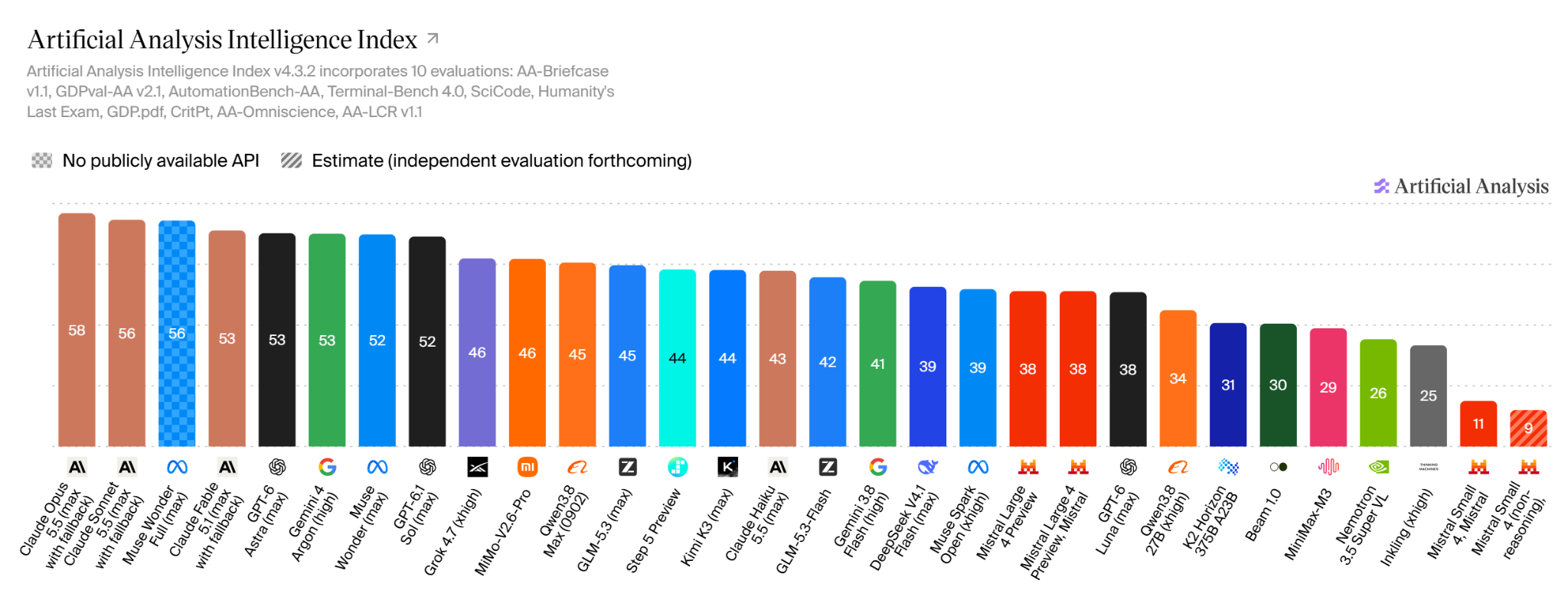
Figure 1 provides the common capability baseline. Mistral Large 4 Preview scores 38. The leading proprietary configurations include Claude Opus 5.5 at 58, Claude Sonnet 5.5 at 56, Claude Fable 5.1, GPT-6 Astra, and Gemini 4 Argon at 53, and Muse Wonder and GPT-6.1 Sol at 52. Muse Wonder Full also scores 56, but the checkered display marks the absence of a publicly available API for that configuration; its accessibility must not be assumed equivalent to an ordinarily purchasable endpoint. These comparisons establish a significant aggregate performance gap between Large 4 and the strongest closed-weight American services, without revealing whether that gap matters for any particular application.
The intermediate band is more relevant to Mistral’s immediate competitive market. MiMo-V2.6-Pro scores 46; GLM-5.3 scores 45; Step 5 Preview and Kimi K3 score 44; GLM-5.3-Flash scores 42; and DeepSeek V4.1 Flash and Muse Spark Open each score 39. GPT-6 Luna scores 38, the same rounded value as Large 4. Thus Mistral is not merely behind American closed models: several Chinese models, including models with downloadable weights, also score higher. Conversely, a difference of one point between Large 4 and a 39-point model does not establish a statistically significant capability difference without confidence intervals and task-level uncertainty. This is a comparison of specified configurations, not a general ranking of entire model families or national research organizations.
The lower end of the chart adds an important caveat about portfolios. Mistral Small 4 scores 11 in the shown evaluated configuration, while the separate non-reasoning entry is estimated at 9. The large separation from Large 4 is not evidence that all European models are weak or that Small 4 is unusable. These artifacts target different resource budgets and deployment conditions. Similarly, neither a high general index score nor a low one establishes that a model is suitable for a particular legal, engineering, multilingual, or safety-critical workflow.
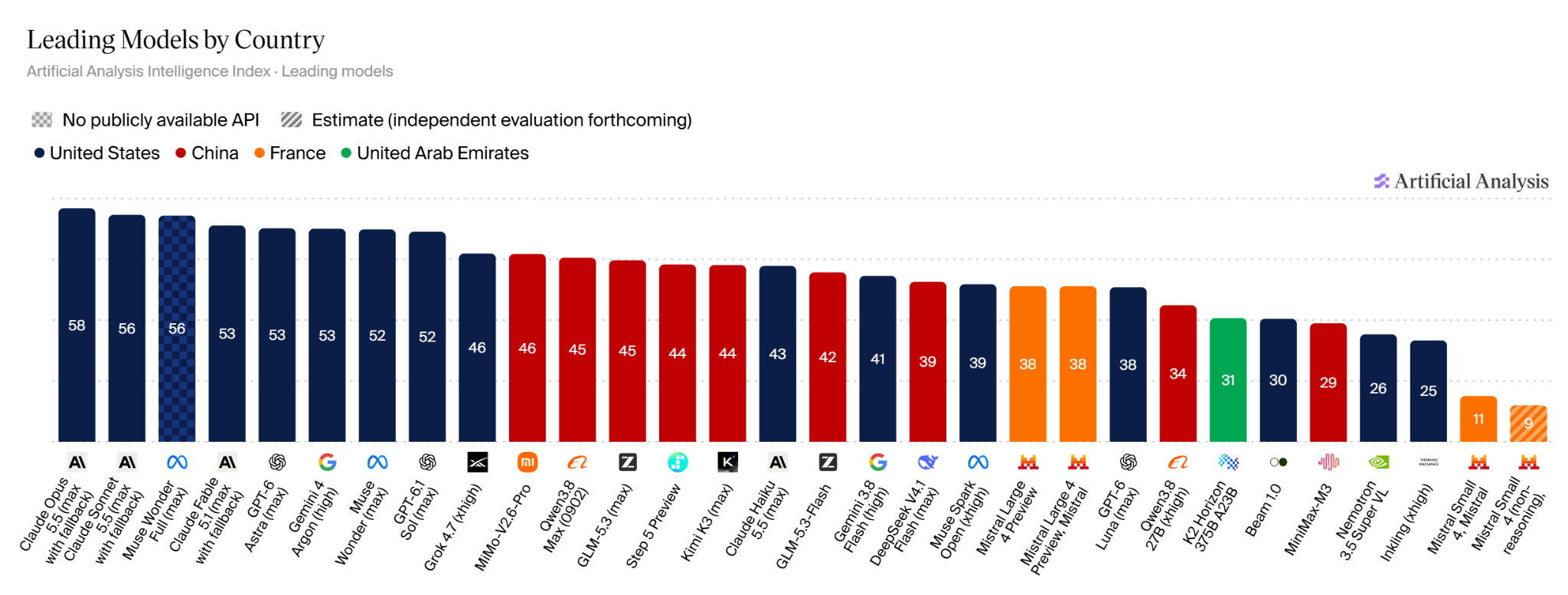
Figure 2 reorganizes the same general-capability results by country of model developer. The highest entries in this selection are associated with the United States, followed by strong models originating in China. Large 4, highlighted under France at 38, is the strongest model from outside those two countries in Artificial Analysis’s dated launch comparison. The United Arab Emirates appears with a lower-scoring representative, K2 Horizon, at approximately 31; countries without a leading model in the selected sample do not appear. The figure supports describing Mistral as a particularly important European commercial producer, but not treating the sample as an exhaustive census of every European model or an evaluation of national innovation systems.42
Country is a property of the model-producing organization, not an observable measure of where all components were manufactured, where inference takes place, who legally controls a checkpoint, or whether an operator can preserve a service after its vendor withdraws. A French model may be trained on US-designed accelerators, while a Chinese open-weight artifact may be lawfully retained and run inside a European-controlled datacentre. This figure is therefore useful for production provenance, and systematically insufficient for deployment, hardware, and reproductive sovereignty.
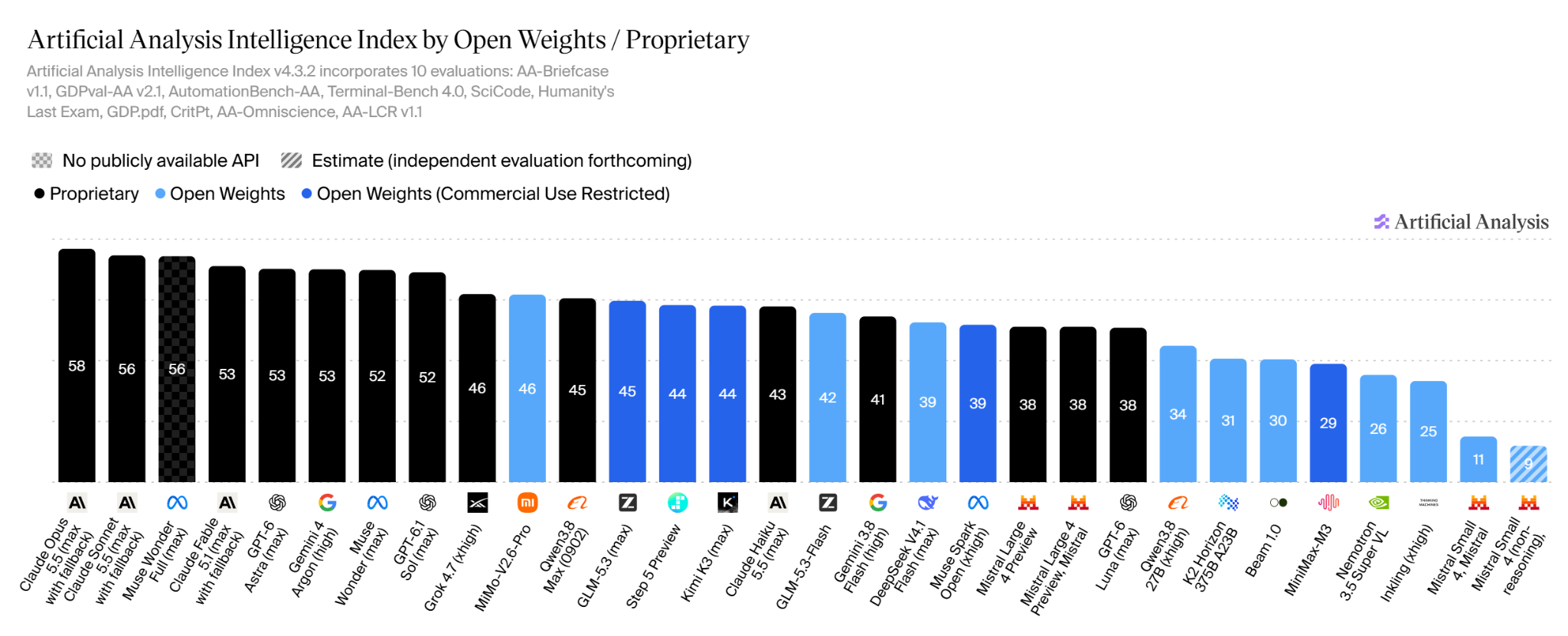
Figure 3 reveals why the sovereignty-relevant comparison is not simply France against US proprietary APIs. The highest-scoring American models are closed-weight in this snapshot, but Meta Muse Spark Open scores 39 and is distributed with downloadable weights under a model-specific license. Chinese downloadable models already appear above Large 4: MiMo-V2.6-Pro at 46, GLM-5.3 at 45, Kimi K3 at 44, GLM-5.3-Flash at 42, and DeepSeek V4.1 Flash at 39. The chart differentiates downloadable weights with and without identified commercial-use restrictions. These classifications are broad and cannot replace inspection of each specific license, including field-of-use restrictions, attribution, commercial-service conditions, or redistribution rights.43
Crucially, Large 4 is marked proprietary at the 18 October cutoff, even though Mistral promised to publish the weights by the end of that month. A planned release is not an independently retainable checkpoint. Earlier Mistral models, by contrast, have been distributed under open-weight licenses and should be evaluated separately. Consequently, at the date shown, a European customer may have stronger artifact-level continuity rights with an appropriately licensed Chinese or American checkpoint than with Large 4’s API preview. This does not imply stronger European model-production sovereignty: possession of foreign weights does not reproduce the research programme, data, training code, or industrial capacity required to train successor models. It distinguishes an autonomous deployment from an autonomous production pipeline.44
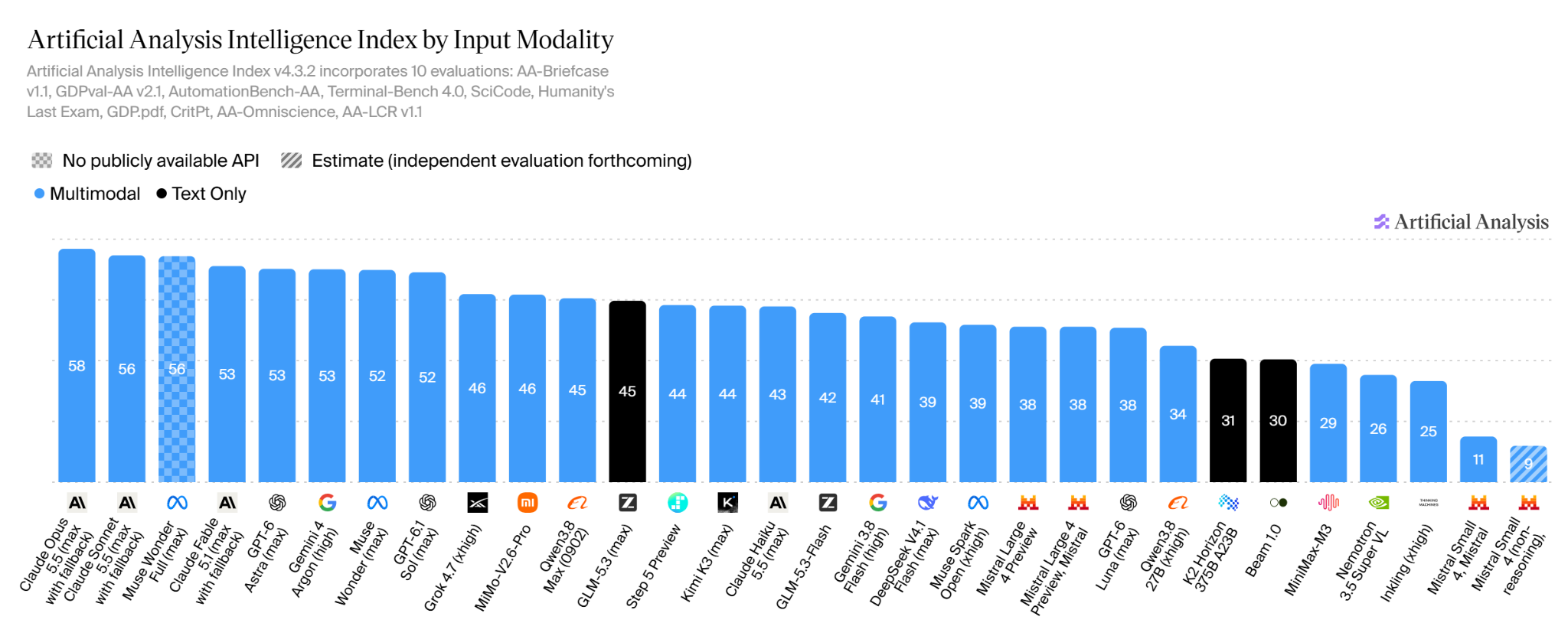
Figure 4 separates text-only from multimodal configurations. Mistral Large 4 is shown as multimodal because it accepts text and images, although its evaluated output is text. Most highest-scoring configurations in the displayed frontier are also multimodal; certain strong systems, including the shown GLM-5.3 configuration, are classified as text-only. The comparison therefore refutes both the assumption that high aggregate scores require identical input modalities and the assumption that a multimodal label proves strong capability at image-rich industrial tasks.
The general index includes some image and document-oriented work, but it does not measure every visual capability: object localization, dense grounding, diagram interpretation, geospatial perception, visual inspection, or large-scale document extraction may differ greatly between models with similar aggregate scores. Mistral’s own launch report cites 42% on Dense 200, compared with approximately 41% for GPT-6 Astra; that is a developer-reported task-specific comparison, not evidence that Large 4 matches Astra on all vision tasks. Artificial Analysis independently reported 19% on GDP.pdf, with part of the gain over Large 3 attributable to the API accepting more images per request. The serving interface and evaluation harness can therefore change observed document performance without demonstrating an equivalent improvement in model weights alone.4546
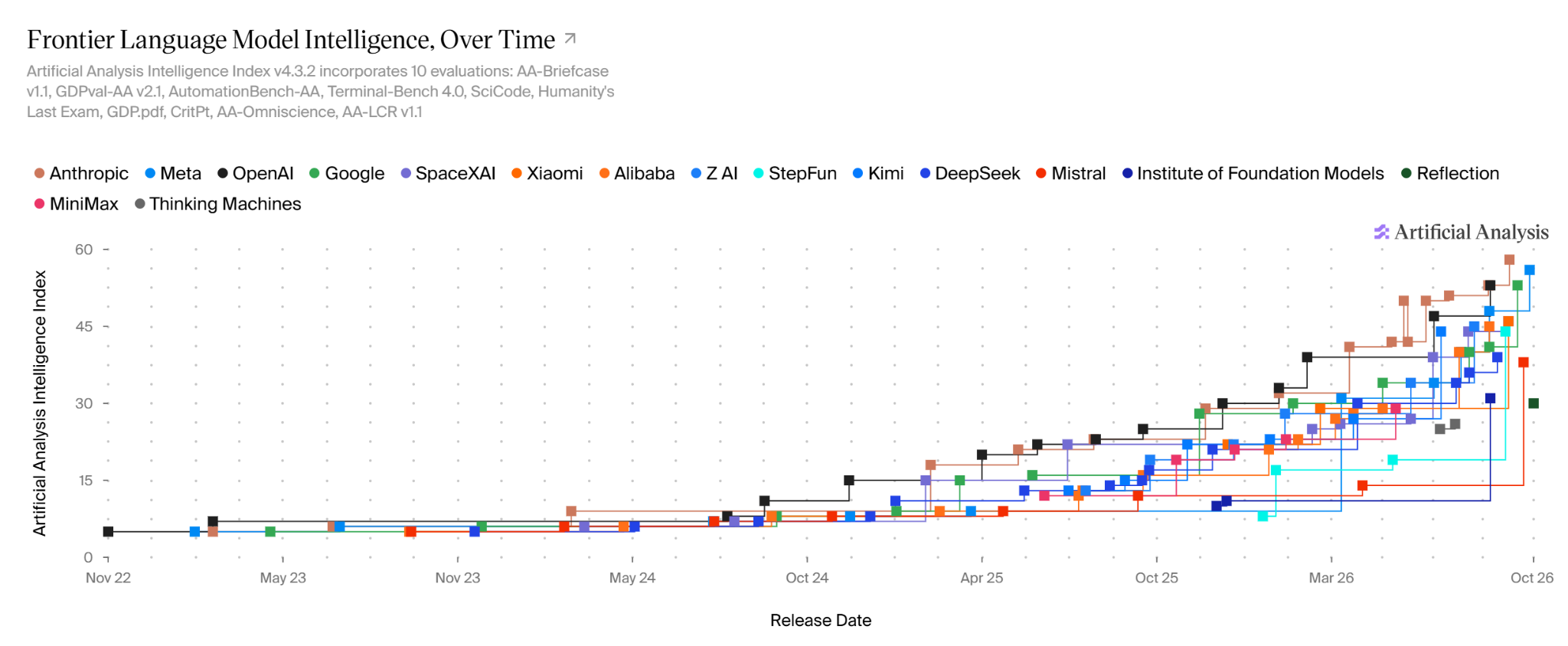
Figure 5 plots changing leading scores by creator against model release dates, expressed using the October 2026 evaluation framework. The rising step patterns illustrate the repeated advance of the strongest American and Chinese model-producing ecosystems. Mistral’s current result is near 38, while the leading contemporaneous configurations approach 58. The chart makes two points that are often confused: Large 4 can improve substantially relative to previous European releases while remaining behind the current frontier; and a historical comparator must be chosen by its measured score on the same benchmark version, not merely by its release date or nominal model generation.
The seven-month analogy is defensible only in a qualified sense. Artificial Analysis’s retrospective catalogue assigns GPT-5.4 xhigh, released 5 March 2026, an estimated score of 39, near Large 4’s independently evaluated 38 on 6 October 2026. This is an approximate score-band match with a model released seven months earlier, not an independently established, statistically tested earliest date when the American frontier first reached 38. It does not characterize GPT-5.4 Pro, task-specific capabilities, or products with different tool and reasoning budgets. Because the historical figure contains many model releases and uses a dense visual encoding, precise earliest-crossing dates must be reconstructed from a versioned model table rather than inferred from pixel positions on its lines.47
Epoch AI yields a different, independently useful historical analogy. Its Epoch Capabilities Index (ECI) assigns approximately 147 to both Large 4 (October 2026) and OpenAI o3 (16 April 2025), almost 18 months apart. It assigns 148 to Chinese open-weight Kimi K2.5 (27 January 2026), roughly eight months before Large 4, and 156 to GLM-5.3 (14 August 2026), ahead of Large 4 even before its release. These ECI observations cannot be subtracted from or converted into Artificial Analysis points. Epoch uses a statistical model spanning a different body of benchmarking evidence, including internally run, third-party, and developer-reported evaluations; differences in estimated scores require attention to uncertainty and configuration. The o3 model profile describes a low-reasoning-effort evaluation, so a matching rounded ECI score does not imply identical reasoning budgets or equally capable product ecosystems.4849505152
| Historical benchmark | Large 4 | Earlier comparator | Comparator date | Illustrative interval |
|---|---|---|---|---|
| Artificial Analysis v4.3.2 | 38 | GPT-5.4 xhigh: 39, estimated | 5 Mar 2026 | ~7 months |
| Epoch ECI | 147 | OpenAI o3: 147 | 16 Apr 2025 | ~18 months |
| Epoch ECI | 147 | Kimi K2.5, open weights: 148 | 27 Jan 2026 | ~8 months |
| Epoch ECI | 147 | GLM-5.3, open weights: 156 | 14 Aug 2026 | Already higher |
Epoch’s separate finding that leading open-weight models lagged the closed-weight frontier by about four months on average early in 2026 describes a changing global open-weight frontier, not Mistral’s own lag. Nor is its later approximately six-to-seven-month finding about the open-weight cybersecurity frontier a valid general-purpose Mistral delay. The correct conclusion is that a model has several workload- and methodology-dependent historical capability relationships, not one universal age or fixed number of months behind.53
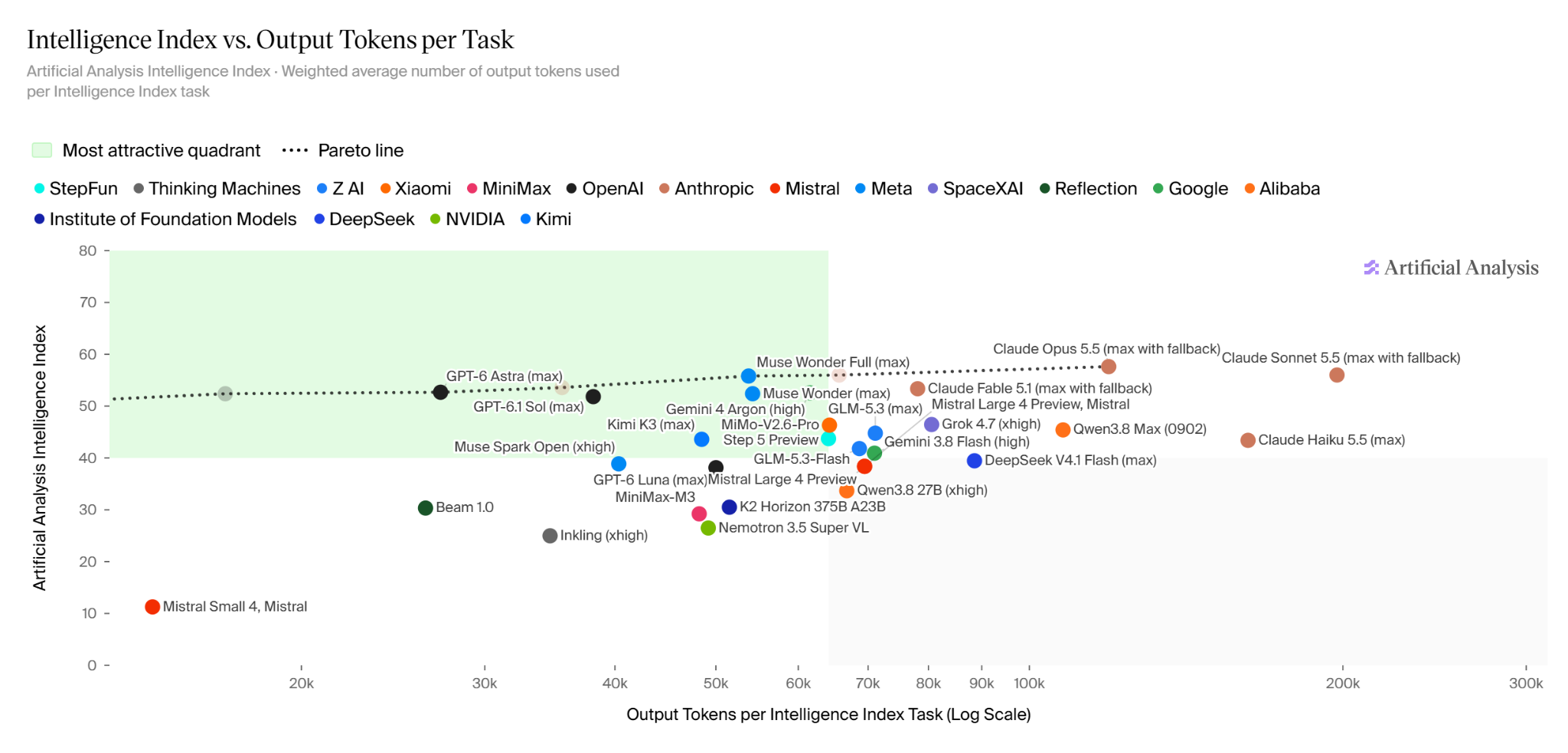
Figure 6 plots model capability against the quantity of generated output per weighted task, with a logarithmic horizontal axis. Mistral Large 4 sits around (69,000 output tokens, 38 index points). Its position is outside the evaluator’s highlighted high-score/low-output quadrant. More importantly, many models offer a higher score while generating fewer output tokens: GPT-6.1 Sol (52, approximately 38k tokens), GPT-6 Astra (53, 27k), Muse Wonder (52, 54k), Gemini 4 Argon (53, 62k), MiMo-V2.6-Pro (46, 64k), Step 5 Preview (44, 64k), Kimi K3 (44, 48k), and Muse Spark Open (39, 40k). GLM-5.3-Flash scores 42 at approximately the same 69k output-token level. The difference between Large 4 and its peers is thus not exclusively a matter of their being allowed to think for longer.
This is a Pareto comparison in two specific measured quantities, not a measure of useful work per joule, FLOP, active parameter, or euro. A model whose output length is lower may have a shorter reasoning trace, produce terser final answers, employ a different tokenizer, or use a provider implementation that exposes different reasoning-token accounting. Additional output tokens may be productive on particularly hard tasks, but the graph does not demonstrate that Large 4 receives a compensating capability benefit on the index’s average workload. The green quadrant is a visualization aid based on the plotted thresholds, while the dotted Pareto boundary applies only to the objectives and models displayed; neither constitutes a universal model-quality optimum.
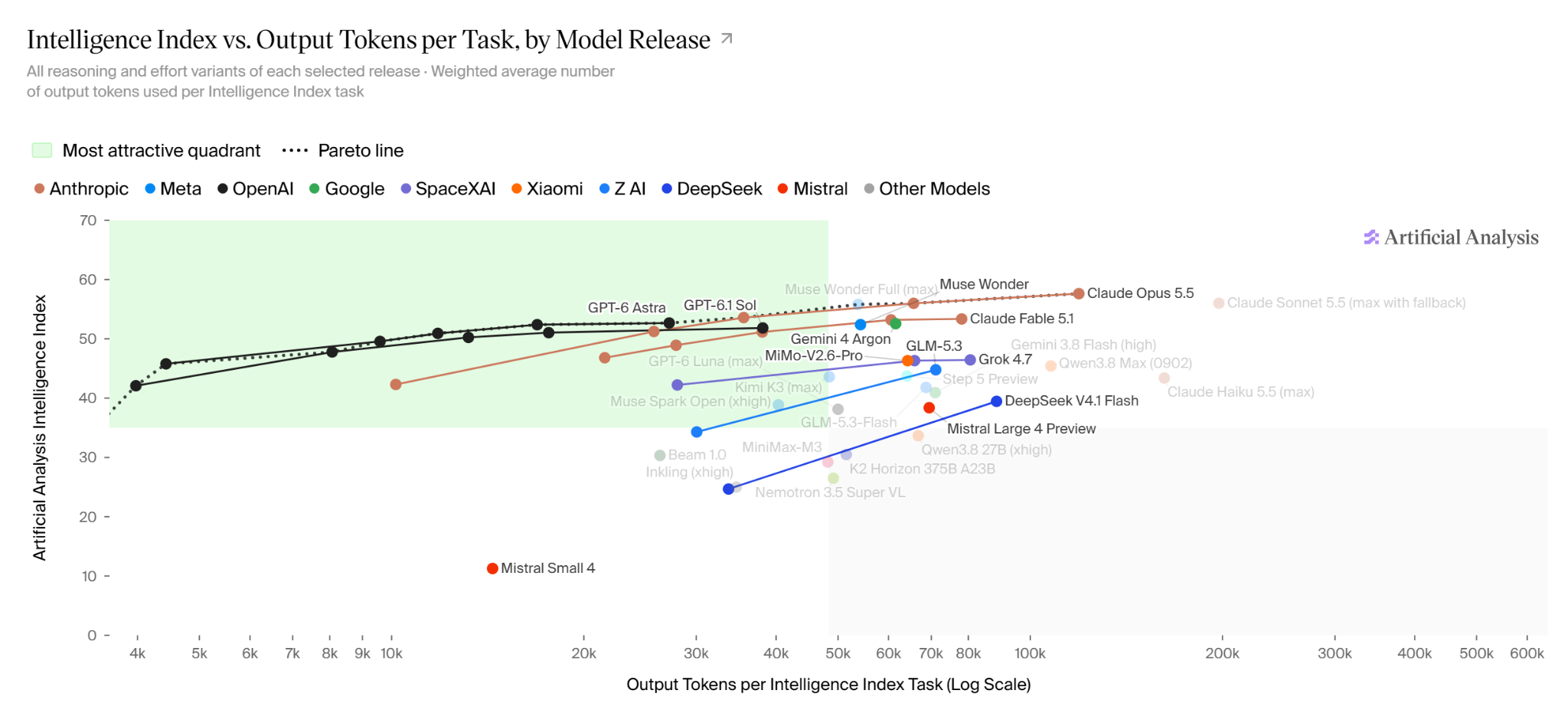
Figure 7 makes the preceding comparison more demanding by displaying multiple reasoning-effort configurations for selected releases. The resulting within-family trajectories show that higher inference-time effort can increase an evaluated score, but not necessarily in proportion to additional generated tokens. The American proprietary frontier contains families whose successive effort levels and releases trace different trade-offs: one configuration may reach a score using many fewer tokens than another family’s high-effort configuration, and the improvement within a family may flatten as token use rises. Large 4 appears as a single preview point rather than a comparable, publicly documented effort-sweep curve.
Consequently, statements such as “Large 4 requires more tokens than GPT-6 Astra to achieve a lower score” are valid descriptions of the plotted endpoint configurations, not proof that one model architecture or one developer is inherently less efficient. A fair research comparison would match task distributions, permitted tools, time limits, compute budgets, and reporting rules and would test several effort settings per model. In addition, the publication of multiple points for one release should not be confused with multiple independent model releases: the release date is shared while the inference-time configuration changes. This distinction is also relevant when constructing historic first-crossing dates; the unit of analysis must be explicit—model family, checkpoint, effort configuration, or deployed service.
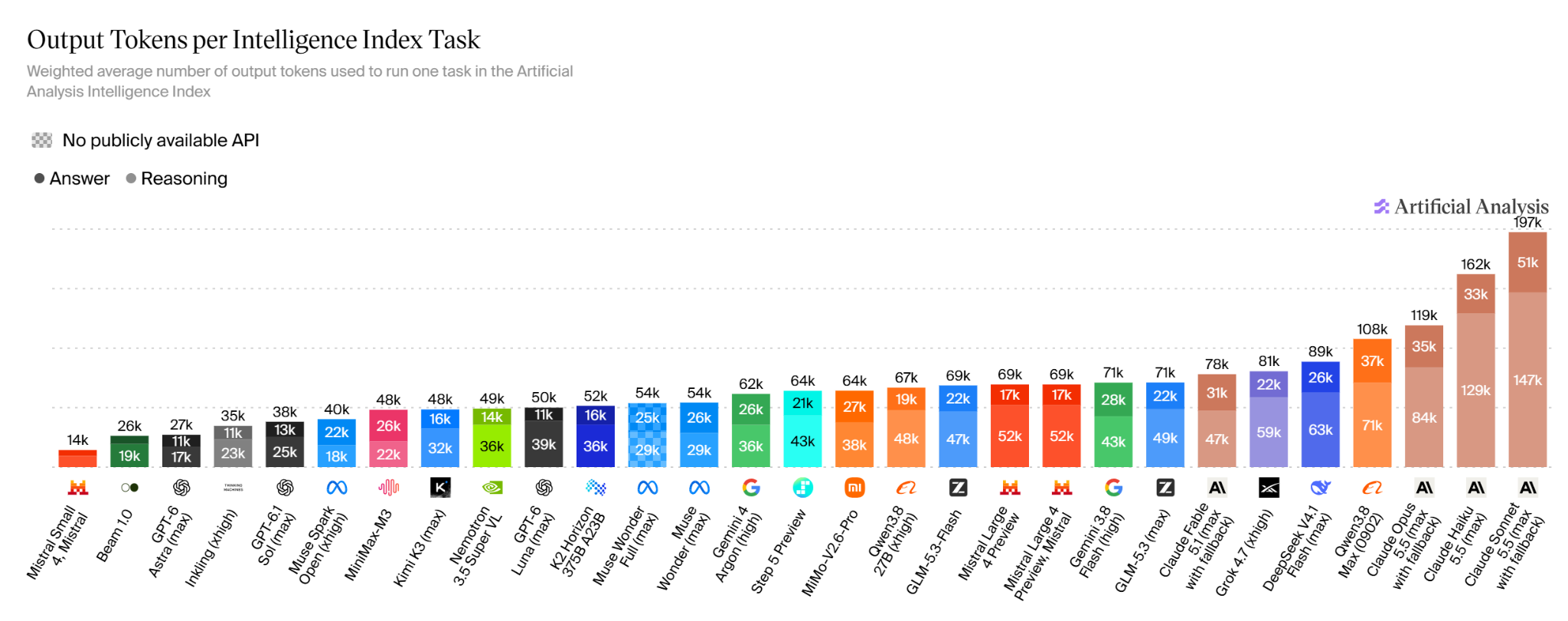
Figure 8 decomposes the token expenditure. Of Large 4’s approximately 69,000 output tokens per weighted task, 52,000 are reasoning tokens and 17,000 answer tokens. Reasoning therefore represents approximately 75% of its output. This split matters because long hidden or visible reasoning traces consume decode capacity and may affect both metered expenditure and response time. It does not, by itself, reveal the quality or necessity of those tokens: an efficiently structured internal computation and a verbose unproductive search can have similar token counts.
The alternatives demonstrate that similar aggregate capability need not entail similar token expenditure. Muse Spark Open uses about 40k tokens (18k reasoning, 22k answer) for an index score of 39, whereas DeepSeek V4.1 Flash reaches the same rounded 39 with 89k output tokens (63k reasoning, 26k answer). GLM-5.3-Flash reaches 42 with 69k tokens (47k reasoning, 22k answer). Conversely, GPT-6 Astra reaches 53 using about 27k output tokens, substantially less than Large 4. These contrasts invalidate the inference that generating more reasoning tokens necessarily means achieving more intelligence; they also explain why a service’s pricing and throughput can make a token-intensive model attractive or unattractive independently of its headline score.
The absolute count is not a hardware-neutral computation metric. Mixture-of-Experts routing, batch utilization, memory traffic, tokenization, attention and tool-execution patterns vary across services. Artificial Analysis’s figures are particularly valuable for comparing observable inference behavior, but it would be methodologically incorrect to convert them directly into training FLOPs or conclude that Mistral used more compute to create Large 4. The model was trained on a substantial European accelerator cluster, but total development-compute accounting is not disclosed on the same basis as competitors.54
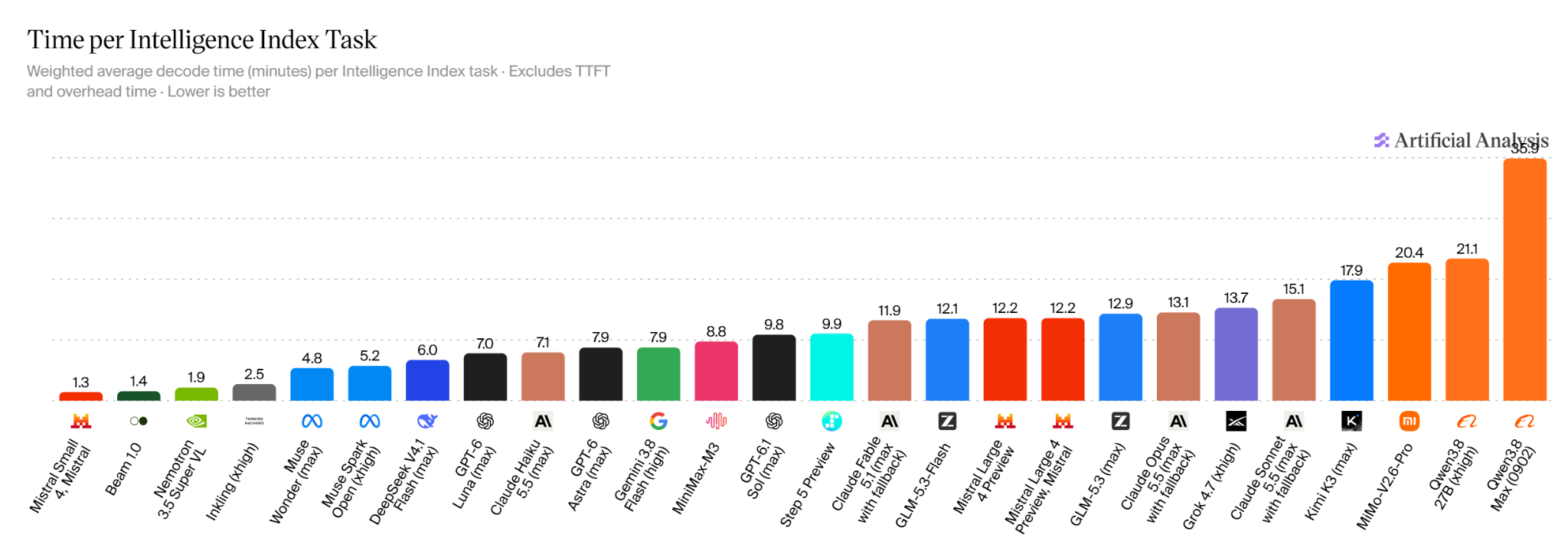
Figure 9 measures a different operating constraint. Large 4 requires approximately 12.2 minutes of weighted decode time, compared with 5.2 minutes for Muse Spark Open, 6.0 for DeepSeek V4.1 Flash, 7.0 for GPT-6 Luna, 7.9 for GPT-6 Astra and Gemini 4 Argon, 9.8 for GPT-6.1 Sol, 9.9 for Step 5 Preview, and 12.1 for GLM-5.3-Flash. The strongest proprietary model in the index, Claude Opus 5.5, requires approximately 13.1 minutes, while MiMo-V2.6-Pro reaches 20.4 minutes despite a higher aggregate score and very low API tariff. This gives latency-sensitive enterprises a genuinely different choice from the one suggested by either capability or list price alone.
The comparison with DeepSeek is especially instructive: it produces roughly 29% more output tokens than Large 4 (89k versus 69k) yet uses about 51% less decode time (6.0 versus 12.2 minutes). This is evidence of a much faster observed inference endpoint on the benchmark workload; it is not evidence that DeepSeek’s architecture is universally faster on identical hardware, or that its training process was more efficient. Differences in provider serving infrastructure, degree of parallelism, request scheduling, cache utilization, and token accounting can affect observed times. Dividing two separately weighted means to derive “tokens per second” would likewise not necessarily reproduce a matched per-task speed comparison.
Nor should these numbers be described as end-to-end customer latency. They exclude TTFT, tool startup and execution, network round trips, retries, and orchestration overhead. Their operational importance is conditional: a twelve-minute decode budget may be acceptable for an overnight report but unusable for a control-room assistant with an interactive response-time objective. Only workload-specific end-to-end testing can establish the actual latency SLA.
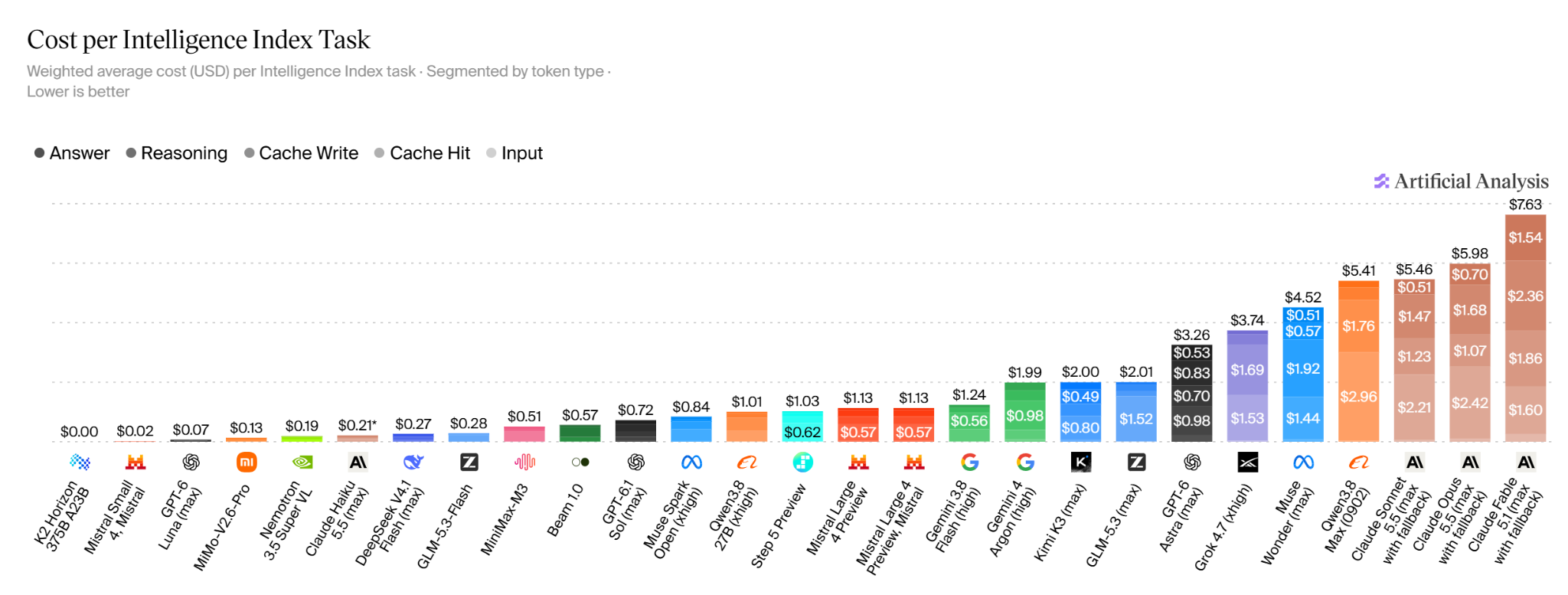
Figure 10 applies published tariffs to the weighted benchmark token mix. At standard list prices, Large 4 costs about $1.13 per index task. This is markedly below expensive frontier proprietary configurations such as GPT-6 Astra ($3.26), Muse Wonder ($4.52), Claude Sonnet 5.5 ($5.46), and Claude Opus 5.5 ($5.98). It is not, however, a general price-performance leader. MiMo-V2.6-Pro costs approximately $0.13 with a score of 46, GLM-5.3-Flash about $0.28 with a score of 42, DeepSeek V4.1 Flash $0.27 with a score of 39, Muse Spark Open $0.84 with a score of 39, and GPT-6.1 Sol $0.72 with a score of 52. Step 5 Preview costs approximately $1.03 while scoring 44. The cheaper models differ in latency, access, license, and capacity, but their existence rules out a general assertion that Mistral offers the least-cost capability in its aggregate performance range.
The status of Mistral’s introductory discount is essential. Its 6 October launch included 50% off for two weeks, making the comparable index cost approximately $0.57 during the promotion rather than $1.13 at standard rates. Some apparent cost advantages against Large 4 disappear during that period: Muse Spark Open at $0.84, GPT-6.1 Sol at $0.72, and Step 5 Preview at $1.03 would then be more expensive, although potentially stronger or faster. GLM-5.3-Flash at $0.28 and GPT-6 Luna at $0.07 remain below Large 4 even at promotional cost. It would be misleading either to treat the temporary discount as the guaranteed long-term price or to ignore it when discussing the actual October purchasing window. The figure also contains very small or zero displayed prices for some other models; in particular, a $0.00 figure associated with an unavailable public endpoint must not be interpreted as a free commercially deployable service.55
These are customer-facing API prices, not the operators’ actual expenditure on accelerators, energy, networking, or personnel. An open-weight model may be deployed by a European enterprise at higher or lower unit cost depending on GPU acquisition, throughput, idle capacity, batch size, system engineering, security, and resilience requirements. A low provider tariff may reflect strategic pricing rather than architectural efficiency. The economic metric of interest for procurement is the cost of an accepted, verified output under required throughput and latency, not price per million generated tokens in isolation.
Table 6 collects the four measurements for a representative sample, adding the GPT-6.1 Sol configuration absent from the earlier draft’s main table. All numbers are read from the supplied 18 October charts. Rounding is material: claims about equality or small differences are descriptive rather than statistically tested.
| Model and configuration | AA Index | Output tokens/task | Decode time/task | Standard API cost/task |
|---|---|---|---|---|
| Claude Opus 5.5 (max, fallback) | 58 | 119k | 13.1 min | $5.98 |
| Claude Sonnet 5.5 (max, fallback) | 56 | 197k | 15.1 min | $5.46 |
| GPT-6 Astra (max) | 53 | 27k | 7.9 min | $3.26 |
| Gemini 4 Argon (high) | 53 | 62k | 7.9 min | $1.99 |
| GPT-6.1 Sol (max) | 52 | 38k | 9.8 min | $0.72 |
| Muse Wonder (max) | 52 | 54k | 4.8 min | $4.52 |
| MiMo-V2.6-Pro | 46 | 64k | 20.4 min | $0.13 |
| GLM-5.3 (max) | 45 | 71k | 12.9 min | $2.01 |
| Step 5 Preview | 44 | 64k | 9.9 min | $1.03 |
| Kimi K3 (max) | 44 | 48k | 17.9 min | $2.00 |
| GLM-5.3-Flash | 42 | 69k | 12.1 min | $0.28 |
| Muse Spark Open (xhigh) | 39 | 40k | 5.2 min | $0.84 |
| DeepSeek V4.1 Flash (max) | 39 | 89k | 6.0 min | $0.27 |
| GPT-6 Luna (max) | 38 | 50k | 7.0 min | $0.07 |
| Mistral Large 4 Preview | 38 | 69k | 12.2 min | $1.13 |
| Mistral Small 4 | 11 | 14k | 1.3 min | $0.02 |
It is useful to formalize the comparison without turning the index into a cardinal notion of intelligence. Let S_m denote model m’s Index score, T_m its output tokens, D_m its decode time, and C_m its API cost under the specific screenshot’s workload and price assumptions. A competitor m weakly improves all four dimensions over Large 4, denoted M, when
S_m \geq S_M,\qquad T_m\leq T_M,\qquad D_m\leq D_M,\qquad C_m\leq C_M, \tag{2}
with at least one strict inequality. This is descriptive four-dimensional Pareto dominance over the rounded benchmark observations, not statistically significant task-by-task superiority and not a claim about training efficiency. Under standard pricing, at least five configurations in the selected observations meet the condition: GPT-6.1 Sol, Step 5 Preview, Muse Spark Open, GLM-5.3-Flash, and GPT-6 Luna. This is more informative than relying only on the two-dimensional Pareto line drawn in the score-versus-token figures. The former two are especially important to acknowledge: one scores 14 points higher with lower tokens, time, and price, while the other scores six points higher with moderately lower resource consumption across all three measured dimensions.
| Comparator against Large 4 | Index difference | Tokens vs 69k | Decode vs 12.2 min | Cost vs $1.13 | Dominates at standard price? |
|---|---|---|---|---|---|
| GPT-6.1 Sol (max) | +14 | 0.55× | 0.80× | 0.64× | Yes |
| Step 5 Preview | +6 | 0.93× | 0.81× | 0.91× | Yes |
| Muse Spark Open (xhigh) | +1 | 0.58× | 0.43× | 0.74× | Yes |
| GLM-5.3-Flash | +4 | 1.00× | 0.99× | 0.25× | Yes, at displayed precision |
| GPT-6 Luna (max) | 0 | 0.72× | 0.57× | 0.06× | Yes, at rounded score equality |
| DeepSeek V4.1 Flash (max) | +1 | 1.29× | 0.49× | 0.24× | No: more tokens |
| MiMo-V2.6-Pro | +8 | 0.93× | 1.67× | 0.12× | No: slower decoding |
| Gemini 4 Argon (high) | +15 | 0.90× | 0.65× | 1.76× | No: higher API cost |
At promotional Large 4 pricing of approximately $0.57 per task, the four-dimensional dominance set contracts: GPT-6.1 Sol, Step 5 Preview, and Muse Spark Open are no longer cheaper, so they cease to dominate on all four criteria. GLM-5.3-Flash and GPT-6 Luna still satisfy the displayed conditions. This sensitivity illustrates why API tariff choices cannot be conflated with technical efficiency. More fundamentally, the dominance relation can reverse again when the objective vector includes a particular cybersecurity benchmark, an essential language, a legal permission, a deployment location, or the right to retain weights. It would be incorrect to conclude that any of these five alternatives is categorically superior to Large 4 for every European industrial workload.
The broad index is not a complete description of security operations, coding-agent behavior, legal research, financial document investigation, or dense visual grounding. Mistral’s launch report makes several claims that require a separate evidence taxonomy: some are independently evaluated by Artificial Analysis, some appear on third-party leaderboards such as Vals AI, and others are vendor-reported experiments whose harness and sampling assumptions must be checked before treating them as comparable measurements.56
| Capability and benchmark | Large 4 | Relevant comparator or limitation | Evidentiary status |
|---|---|---|---|
| Artificial Analysis Cyber Index | 50 points | GLM-5.3-Flash 50; MiMo-V2.6-Pro 56 | Independent specialist composite |
| CyberGym-E2E-AA | 82% | MiMo-V2.6-Pro 79%; GPT-6 Luna 78% | Independent; component evaluation |
| Cybench | 93% | Some competitor scores affected by provider refusals | Developer-reported |
| DeepSWE v1.1 | 61.7% | Selected software-agent comparators | Developer-reported |
| SWE-Atlas-QnA | 59.4% | Repository understanding | Developer-reported |
| Terminal-Bench 4.0 | 28.3% | Independent evaluation may differ by harness | Developer-reported |
| AutomationBench | 59.9% | Broadly similar to independent AutomationBench-AA result | Developer-reported with related external evaluation |
| Finance Agent v2 | 54.68% | GPT-6 Astra 53.54% | Third-party Vals AI |
| Harvey Legal Agent | 15.83% | GPT-6 Astra 5.42% | Third-party Vals AI |
| Dense 200 visual grounding | 42% | GPT-6 Astra approximately 41% | Developer-reported |
The strongest external corroboration concerns cybersecurity. Large 4’s Cyber Index score of 50 is below MiMo-V2.6-Pro’s 56, but it achieves the leading published 82% on CyberGym-E2E-AA, ahead of the selected competitors. This matters because CyberGym exercises source-code-based exploitation and patching workflows rather than ordinary security trivia. However, the primary pass criterion is not equivalent to a guarantee that the patch fixes the ground-truth target vulnerability: Artificial Analysis records that outcome separately. Reporting the result as an independently verified 82% vulnerability-remediation rate would therefore overstate what the benchmark establishes. Mistral’s reported 93% Cybench result is also relevant to authorized security testing, but some closed systems refuse tasks for policy reasons, complicating comparisons of raw model competence with practical API usefulness.5758
The business benchmarks show a narrower but consequential form of competitiveness. Vals AI reports 54.68% on Finance Agent v2 for Large 4 against 53.54% for GPT-6 Astra: a 1.14-percentage-point difference, not proof of general financial superiority. The associated API cost per evaluation is approximately $1.20 versus $6.82, while Large 4 reportedly takes about 26 minutes versus 12 minutes for Astra. This is evidence of an application-specific quality–price–latency trade-off, not an alternative measurement of the AA $1.13 weighted index cost. On Harvey’s Legal Agent Benchmark, Large 4 scores 15.83% versus 5.42% for Astra, a major relative advantage but a low absolute full-task success rate. Other legal and spreadsheet evaluations yield materially different results, so it would be misleading to infer general legal or financial dominance from the most favorable benchmarks.5960
Mistral also reports 61.7% DeepSWE, 59.4% SWE-Atlas-QnA, 28.3% Terminal-Bench 4.0, 59.9% AutomationBench, and 42% Dense 200. These scores are relevant for engineering and enterprise workflows, but mixing them with the Artificial Analysis index without matching versions and configurations risks double counting, cherry-picking, and apparent discrepancies caused by tools, prompts, allowed time, or scoring rules. The independent data justify saying that Large 4 is competitive and sometimes leading on particular high-value tasks. They do not justify claiming generalized parity with the contemporary American frontier or superiority to the leading Chinese open-weight ecosystem on every workload.
The ten charts, combined with Epoch and specialized benchmark evidence, yield a result that is more discriminating than either a celebratory benchmark table or a simple global leaderboard. On broad aggregate capability, Large 4 is clearly below the strongest closed-weight American models and below several Chinese downloadable systems. On selected security and professional-agent tasks, it performs much closer to leading alternatives and can outperform some of them. On measured inference-service expenditure, its output-token and decode-time budgets are high relative to several peers, and its standard API price is not on the leading cost frontier; the temporary October discount improves but does not erase every unfavorable comparison. On artifact independence, its weights were still unpublished on the cutoff date, unlike the released open-weight alternatives. These findings are simultaneously true because the charts measure different dimensions.
The strategic value of Mistral consequently lies less in converting a 38-point benchmark score into a universal technology-lag statistic than in demonstrating a European organization capable of designing, training, evaluating, and operating successive advanced models. That is a real addition to European model-production sovereignty. Meanwhile, an appropriately licensed American or Chinese open-weight model may provide stronger immediate deployment independence for a European enterprise if it meets that enterprise’s validated workload requirements. Neither nationality nor self-hosting alone guarantees security, legal compliance, hardware independence, or the ability to train a successor.
The relevant procurement test should begin with reproducible task-level acceptance criteria and a declared time horizon: required accuracy and recovery from errors; full-stack latency and concurrency; energy and accelerator requirements; the legal right to retain and adapt the checkpoint; data residency and administrative control; contractual exit; and the capacity to maintain the service when a provider or a critical supplier disappears. Under those conditions, different models may be preferred for different strategic applications. Broad benchmark scores, specialized success rates, token budgets, API prices, and Epoch historical comparisons are useful inputs to that decision—but no one of them is a substitute for it.







Mistral AI. (2026, October 6). Introducing Mistral Large 4. Official model announcement describing the API preview, architecture, 3,800 Grace Blackwell GPUs, planned weight publication, reinforcement-learning infrastructure, and vendor benchmark results. Official announcement↩︎
Artificial Analysis. (2026, October 6). Mistral has released Mistral Large 4, making France home to the most intelligent model outside the US and China. Independent intelligence and cyber evaluations, pricing and context-window information, model-access status, and discussion of API-driven improvements in GDP.pdf. Independent release evaluation↩︎
Montano, A. (2026, October 5; revised October 7). How Sovereign Is Kolibri? Random Bits of Knowledge. Detailed analysis of Aleph Alpha’s model-production and deployment controls, external synthetic-data teachers, NVIDIA infrastructure, and corporate governance. Previous article↩︎
Mistral AI. (2025, December 2). Introducing Mistral 3. Architecture, weights, training hardware, license, and portfolio details for Mistral Large 3 and Ministral 3. Official model release↩︎
Mistral AI. (2026, March 16). Introducing Mistral Small 4. Architecture, configurable reasoning and weight-availability details. Official model release↩︎
Mistral AI. (2026). Mistral Medium 3.5. Model specifications and licensing. Official model documentation↩︎
Artificial Analysis. (2026, October 6). Mistral has released Mistral Large 4, making France home to the most intelligent model outside the US and China. Independent intelligence and cyber evaluations, pricing and context-window information, model-access status, and discussion of API-driven improvements in GDP.pdf. Independent release evaluation↩︎
Mistral AI. (2026, October 6). Introducing Mistral Large 4. Official model announcement describing the API preview, architecture, 3,800 Grace Blackwell GPUs, planned weight publication, reinforcement-learning infrastructure, and vendor benchmark results. Official announcement↩︎
Artificial Analysis. (2026, October 6). Mistral has released Mistral Large 4, making France home to the most intelligent model outside the US and China. Independent intelligence and cyber evaluations, pricing and context-window information, model-access status, and discussion of API-driven improvements in GDP.pdf. Independent release evaluation↩︎
Mistral AI. (2026, October 6). Introducing Mistral Large 4. Official model announcement describing the API preview, architecture, 3,800 Grace Blackwell GPUs, planned weight publication, reinforcement-learning infrastructure, and vendor benchmark results. Official announcement↩︎
OpenAI. (2026, March 5). Introducing GPT-5.4. Model and release details, configurations, and vendor evaluations. Official announcement↩︎
Artificial Analysis. (2026). GPT-5.4 (xhigh). Retrospective catalogue entry indicating a 39-point estimated Intelligence Index score and the 5 March 2026 release. Model evaluation↩︎
Artificial Analysis. (2026, September 7). Announcing the Artificial Analysis Intelligence Index v4.3. Documents evaluation replacements, task categories, benchmark weights, and the v4.3.2 suite. Benchmark methodology↩︎
Epoch AI. (2026). Mistral Large 4. Model profile giving the 6 October 2026 release, closed-weight status at the cutoff, ECI point estimate 147, and benchmark comparisons. Independent model evaluation↩︎
Epoch AI. (2026). o3. Profile for OpenAI’s 16 April 2025 model with ECI approximately 147. Historical model evaluation↩︎
Epoch AI. (2026). Kimi K2.5. Moonshot open-weight model released on 27 January 2026, with ECI approximately 148. Historical model evaluation↩︎
Epoch AI. (2026). GLM-5.3. Z.ai open-weight model released on 14 August 2026, with ECI approximately 156. Historical model evaluation↩︎
Edwards, J., and Emberson, L. (2026, May 29). Open models lag state-of-the-art closed models by 4 months. Epoch AI. Explains its retrospective daily frontier methodology, bootstrap criterion, and alternative six-month point-estimate interpretation. Research analysis↩︎
Epoch AI. (2026, October 16). Open-weight models trail closed models in cyber capabilities by 6–7 months. Domain-specific historical capability comparison identifying GLM-5.3 as the leading open-weight model on Cyber ECI. Research publication listing↩︎
Artificial Analysis. (2026). Claude Opus 5.5 and GPT-6 Astra. Model-release evaluations assigning the strongest listed configurations Intelligence Index scores of 58 and 53, respectively. Anthropic release evaluation. OpenAI model evaluation↩︎
Artificial Analysis. (2026, October 6). Mistral has released Mistral Large 4, making France home to the most intelligent model outside the US and China. Independent intelligence and cyber evaluations, pricing and context-window information, model-access status, and discussion of API-driven improvements in GDP.pdf. Independent release evaluation↩︎
Artificial Analysis. (2026). Muse Spark Open. Model profile assigning the 15 October open-weight release a score of 39 and identifying its model-specific license. Independent model evaluation. Meta Platforms. (2026). Muse Model License. Model license↩︎
Artificial Analysis. (2026). Model evaluations: MiMo-V2.6-Pro evaluation, GLM-5.3 evaluation, Kimi K3 evaluation, GLM-5.3-Flash evaluation, and DeepSeek V4.1 Flash evaluation. Scores refer to specified variants and reasoning settings.↩︎
Examples of different conditions: Meta. Muse Model License. Model license; Moonshot AI. Kimi K3 License. Model license; Alibaba Qwen. Qwen Community License 1.0. Model license. A model’s downloadable status does not establish that any of these licenses is equivalent to the others.↩︎
Artificial Analysis. (2026, October 6). Mistral has released Mistral Large 4, making France home to the most intelligent model outside the US and China. Independent intelligence and cyber evaluations, pricing and context-window information, model-access status, and discussion of API-driven improvements in GDP.pdf. Independent release evaluation↩︎
DeepSeek-AI. (2024). DeepSeek-V3 Technical Report. Bounded estimate of GPU-hours for reported training stages and an assumed compute-rental cost, explicitly excluding preceding research, ablations, and other development expenditure. Technical report↩︎
Mistral AI. (2026). Making sovereign, open-weight AI the technology frontier. Official announcement of its €3 billion Series D led by Samsung Electronics and supporting industrial expansion plans. Financing announcement↩︎
Mistral AI. (2026, March 17). Introducing Forge. Commercial platform for enterprise model training, adaptation, evaluation, and deployment. Official announcement↩︎
Montano, A. (2026, October 5; revised October 7). How Sovereign Is Kolibri? Random Bits of Knowledge. Detailed analysis of Aleph Alpha’s model-production and deployment controls, external synthetic-data teachers, NVIDIA infrastructure, and corporate governance. Previous article↩︎
Mistral AI. (2026, August 11). In-region inference, open models, and new European infrastructure for sovereign AI. Regional deployment, third-party models, stated processing conditions, and future compute plans. Official infrastructure announcement↩︎
NVIDIA. CUDA Programming Guide and NCCL User Guide. Technical specifications for the GPU runtime, device programming model, and distributed collective communication. CUDA documentation. NCCL documentation↩︎
ETH Zurich, EPFL, and CSCS. (2025, September 2). Apertus: a fully open, transparent, multilingual language model. Institutional description of weights, training methods, published artifacts, and publicly available model sizes. Institutional announcement↩︎
EuroLLM Consortium. (2026). EuroLLM. Project website. OpenEuroLLM Consortium. (2026). OpenEuroLLM. Project website. These are separate initiatives with different institutional and technical scopes.↩︎
European Parliament and Council. (2024). Regulation (EU) 2024/1689, Article 53, on general-purpose AI model-provider obligations. Official text. European Parliament and Council. (2023). Regulation (EU) 2023/2854 (Data Act), Chapter VI, on switching between qualifying data-processing services. Official text↩︎
European High Performance Computing Joint Undertaking. (2026, July 30). Call for tenders for the selection of Artificial Intelligence Gigafactory Consortia and the establishment of AI Gigafactories. Reference EUROHPC-2026-CEI-AIGF-01; the programme page currently shows a 3 December 2026 deadline. Official procurement notice↩︎
European Commission. (2025, October 8). Apply AI Strategy. Industrial and public-sector application priorities, support for adoption, and European capabilities. Official strategy↩︎
Mistral AI. (2026, March 16). Mistral partners with NVIDIA to accelerate open frontier models. Partnership announcement. Microsoft and Mistral AI. (2026, July 21). Microsoft and Mistral expand strategic partnership. Partnership announcement↩︎
Artificial Analysis. Language Model Benchmarking Methodology. Definitions of model, endpoint, open weights, token accounting, weighted index cost per task and API performance. https://artificialanalysis.ai/methodology/.↩︎
Artificial Analysis. (6 October 2026). Mistral has released Mistral Large 4, making France home to the most intelligent model outside the US and China. Independent general and cyber indices, model availability, API prices, promotion and document-evaluation caveat. https://artificialanalysis.ai/articles/mistral-large-4-france-ai/.↩︎
Artificial Analysis. (7 September 2026, as displayed in its v4.3.2 revision). Announcing the Artificial Analysis Intelligence Index v4.3. Ten component evaluations and weighting by agents, coding, general capabilities and scientific reasoning. https://artificialanalysis.ai/articles/artificial-analysis-intelligence-index-v4-3.↩︎
Artificial Analysis. Language Model Benchmarking Methodology. Definitions of model, endpoint, open weights, token accounting, weighted index cost per task and API performance. https://artificialanalysis.ai/methodology/.↩︎
Artificial Analysis. (6 October 2026). Mistral has released Mistral Large 4, making France home to the most intelligent model outside the US and China. Independent general and cyber indices, model availability, API prices, promotion and document-evaluation caveat. https://artificialanalysis.ai/articles/mistral-large-4-france-ai/.↩︎
Artificial Analysis. Language Model Benchmarking Methodology. Definitions of model, endpoint, open weights, token accounting, weighted index cost per task and API performance. https://artificialanalysis.ai/methodology/.↩︎
Mistral AI. (6 October 2026). Introducing Mistral Large 4. Technical architecture, planned weight publication, European training infrastructure and company-reported specialized benchmarks. https://mistral.ai/news/mistral-large-4/.↩︎
Mistral AI. (6 October 2026). Introducing Mistral Large 4. Technical architecture, planned weight publication, European training infrastructure and company-reported specialized benchmarks. https://mistral.ai/news/mistral-large-4/.↩︎
Artificial Analysis. (6 October 2026). Mistral has released Mistral Large 4, making France home to the most intelligent model outside the US and China. Independent general and cyber indices, model availability, API prices, promotion and document-evaluation caveat. https://artificialanalysis.ai/articles/mistral-large-4-france-ai/.↩︎
Artificial Analysis. GPT-5.4 model evaluation: retrospective estimated index score and dated model release. https://artificialanalysis.ai/models/gpt-5-4. OpenAI. (5 March 2026). Introducing GPT-5.4. https://openai.com/index/introducing-gpt-5-4/.↩︎
Epoch AI. Mistral Large 4 model profile. ECI 147; release 6 October 2026; closed weights at evaluation. https://epoch.ai/models/mistral-large-4.↩︎
Epoch AI. o3 model profile. ECI 147; release 16 April 2025; evaluated configuration specified in the profile. https://epoch.ai/models/o3.↩︎
Epoch AI. Kimi K2.5 model profile. ECI 148; open weights; release 27 January 2026. https://epoch.ai/models/kimi-k2-5.↩︎
Epoch AI. GLM-5.3 model profile. ECI 156; open weights; release 14 August 2026. https://epoch.ai/models/glm-5-3.↩︎
Epoch AI. Interpreting the Epoch Capabilities Index. Model-based aggregation of internal, external, and developer-reported benchmark evidence, including uncertainty. https://epoch.ai/data-insights/interpreting-eci.↩︎
Edwards, J., and Emberson, L. (29 May 2026). Open models lag state-of-the-art closed models by 4 months. Epoch AI. Describes a historical average between open- and closed-weight frontiers, not the lag of a specific company. https://epoch.ai/data-insights/open-closed-eci-gap.↩︎
Mistral AI. (6 October 2026). Introducing Mistral Large 4. Technical architecture, planned weight publication, European training infrastructure and company-reported specialized benchmarks. https://mistral.ai/news/mistral-large-4/.↩︎
Artificial Analysis. (6 October 2026). Mistral has released Mistral Large 4, making France home to the most intelligent model outside the US and China. Independent general and cyber indices, model availability, API prices, promotion and document-evaluation caveat. https://artificialanalysis.ai/articles/mistral-large-4-france-ai/.↩︎
Mistral AI. (6 October 2026). Introducing Mistral Large 4. Technical architecture, planned weight publication, European training infrastructure and company-reported specialized benchmarks. https://mistral.ai/news/mistral-large-4/.↩︎
Artificial Analysis. (6 October 2026). Mistral has released Mistral Large 4, making France home to the most intelligent model outside the US and China. Independent general and cyber indices, model availability, API prices, promotion and document-evaluation caveat. https://artificialanalysis.ai/articles/mistral-large-4-france-ai/.↩︎
Artificial Analysis. (28 September 2026). Announcing the Artificial Analysis Cyber Index Alliance. CyberGym-E2E-AA task design, refusal accounting and ground-truth vulnerability verification limits. https://artificialanalysis.ai/articles/artificial-analysis-cyber-index/.↩︎
Vals AI. Finance Agent v2. Third-party model scores and reported test costs and durations. https://www.vals.ai/benchmarks/fabv2.↩︎
Vals AI. Mistral Large 4 model evaluation. Harvey legal-agent, legal-research, spreadsheet and financial comparisons; scores and model populations may update. https://www.vals.ai/models/mistralai_mistral-large-4.↩︎