Homomorphic Encryption for Developers
From algebraic foundations and textbook RSA to practical BFV and dependable private computation
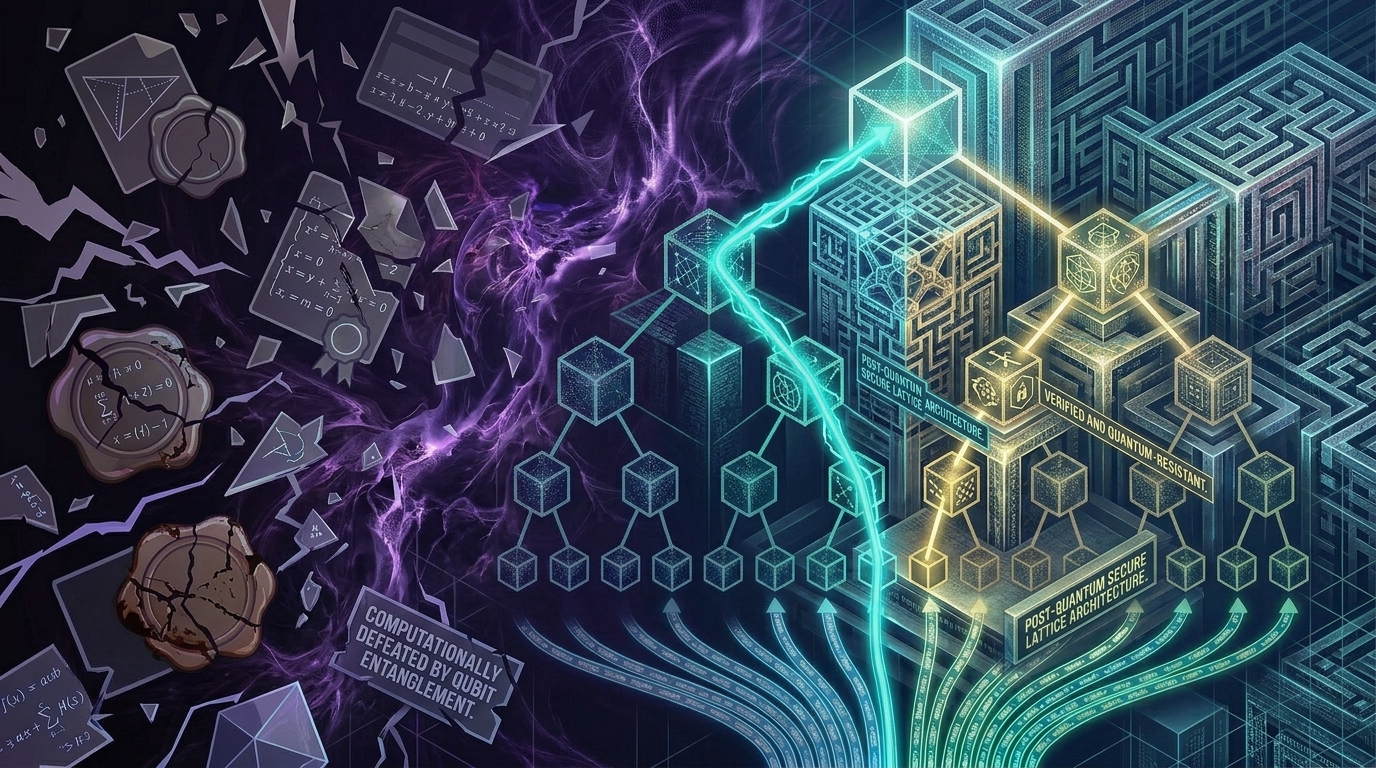
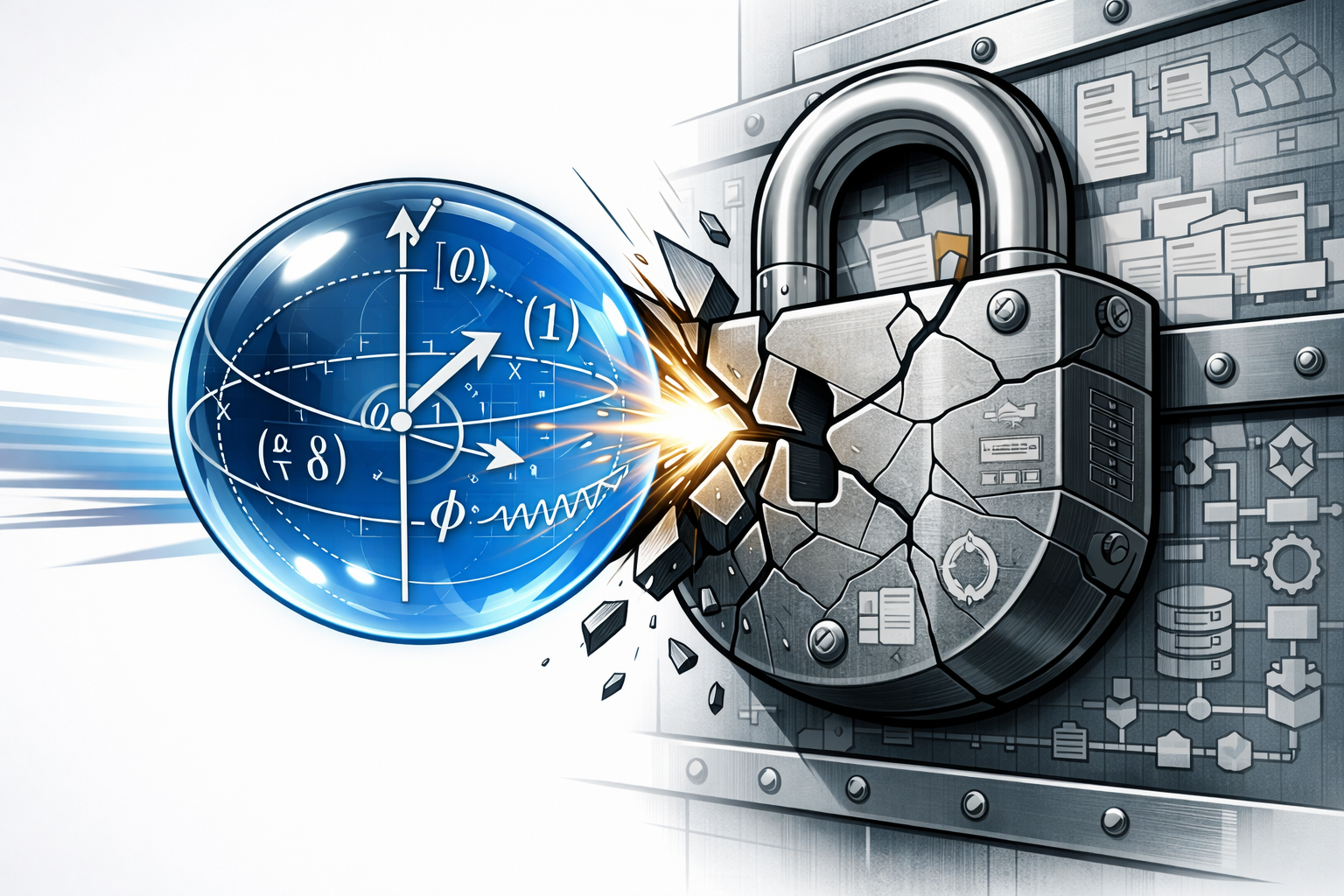
Quantum computing does not invalidate cryptography as a whole. Its principal structural effect is to undermine the mathematical hardness assumptions supporting widely deployed public-key systems, including RSA and elliptic-curve cryptography. Symmetric cryptography remains viable with appropriately selected parameters, but key establishment, authentication, digital signatures, certificates, secure boot, software provenance, and other public-key trust functions require replacement mechanisms.
Two technologies are commonly proposed in response: Quantum Key Distribution and post-quantum cryptography. Although they are frequently discussed as competing approaches, they operate at different layers and provide different security properties. QKD uses quantum states to establish shared symmetric keys and can make interception of the quantum channel detectable under its security assumptions. It does not, however, authenticate endpoints, sign software or documents, bind identities to keys, or preserve the verifiability of artifacts across time.
PQC consists of classical cryptographic algorithms designed to resist known quantum attacks. It can replace vulnerable public-key primitives within existing communication, identity, certificate, and signature infrastructures. PQC therefore addresses the complete functional surface of public-key cryptography: key establishment, authentication, digital signatures, and long-term verification. Its security remains computational and assumption-dependent, but it can be deployed through software and protocol evolution without requiring dedicated quantum channels.
The relationship between the two approaches is asymmetric. QKD requires an authenticated classical channel to prevent active impersonation and man-in-the-middle attacks. In a quantum-capable threat model, that authentication must itself remain secure against quantum attacks and may therefore be provided through post-quantum signatures or previously established symmetric authentication. PQC does not require QKD and can independently provide both authenticated key establishment and digital signatures. QKD can consequently augment a post-quantum architecture in selected environments, but it cannot replace its trust infrastructure.
This distinction becomes clearer when quantum risk is examined temporally. Harvest-now-decrypt-later attacks threaten the future confidentiality of data captured today, while quantum forgery threatens the authenticity of certificates, firmware, software updates, contracts, audit records, and other long-lived signed artifacts. QKD protects neither previously captured information nor the future verifiability of historical signatures. Its effect is confined to the establishment of present-time symmetric keys over supported links.
The article concludes that a coherent quantum-safe strategy must preserve three properties simultaneously: secure communication, authenticated identity, and durable verification of digital artifacts. PQC is structurally required across enterprise, cloud, industrial, embedded, and public infrastructures because it addresses all three. QKD remains a specialized and infrastructure-intensive option for narrowly bounded communication scenarios in which its physical assumptions, operational limitations, and cost are justified.
Quantum Key Distribution and post-quantum cryptography are often presented as alternative responses to quantum computing, although they solve different problems. This article separates confidentiality, key establishment, authentication, digital signatures, and long-term verifiability to show why PQC is the structural basis of quantum-safe digital trust, while QKD remains an optional mechanism for distributing symmetric keys under restrictive physical and operational assumptions.
Quantum computing introduces a discontinuity in the security assumptions that underpin modern digital systems. This discontinuity is often described imprecisely as breaking cryptography, a simplification that obscures both the real nature of the threat and the appropriate response.
Two families of countermeasures dominate the discussion: Quantum Key Distribution (QKD) and post-quantum cryptography (PQC). They are frequently mentioned together, sometimes even contrasted as competing solutions. In reality, they address different problems, operate at different layers of the security stack, and rely on fundamentally different trust models.
This article proceeds in two passes. First, the concepts are introduced in intuitive terms, focusing on meaning and practical implications. Second, each concept is formalized and positioned within a coherent security architecture.
The objective is not advocacy, but conceptual clarity and correct architectural reasoning.
Most secure digital interactions rely on public key cryptography. This includes HTTPS connections, software updates, digital identities, electronic signatures, and secure boot mechanisms. The security of these systems rests on mathematical problems that are hard for classical computers to solve.
Quantum computers change this by making some of those problems efficiently solvable. In particular, they undermine widely deployed public key algorithms such as RSA and elliptic curve cryptography.
However, it is critical to state precisely what does not change. Quantum computers do not break cryptography in general. Symmetric encryption algorithms such as AES are affected only quantitatively, not structurally. Known quantum attacks reduce their effective security but do not invalidate their design. Increasing key sizes restores security margins.
The damage caused by quantum computing is therefore specific and structural: the collapse of public key assumptions, not the disappearance of encryption as a whole.
From a non specialist perspective, two responses appear natural.
The first is to use quantum physics itself to secure communications. If physical laws guarantee secrecy, mathematical attacks become irrelevant. This intuition leads to QKD.
The second is to replace broken algorithms with new ones that quantum computers cannot efficiently attack. This leads to PQC. At an intuitive level, the two approaches may appear equivalent. They are not.
QKD is a method for securely sharing secret keys by transmitting quantum states over a dedicated channel. Any attempt to intercept these states inevitably disturbs them, making eavesdropping detectable.
The promise is strong: if an attacker listens, the communicating parties can detect it and discard the key.
However, QKD does exactly one thing. It helps two parties agree on a shared secret.
It does not prove who those parties are. It does not secure software updates. It does not sign documents. It does not allow verification years later.
QKD can therefore be understood as a highly secure courier for short-lived secrets, not as a general mechanism for digital trust.
PQC, by contrast, replaces today’s vulnerable public key algorithms with new ones believed to resist quantum attacks. From a user’s perspective, nothing fundamentally changes. Browsers still use TLS. Software is still signed. Certificates still exist. The difference lies entirely in the mathematics beneath.
PQC is not based on quantum physics. It is classical cryptography designed to remain secure in a world with quantum computers. Unlike QKD, PQC covers all functions currently served by public key cryptography, including authentication, signatures, and long-term verification.
To reason rigorously, the security problem must be decomposed into functions. Modern digital systems rely on public key cryptography for three distinct purposes:
Quantum computing compromises all three by invalidating the hardness assumptions underlying RSA, DSA, and elliptic curve schemes.
A complete mitigation strategy must therefore address all three functions simultaneously, not only confidentiality of future communications.
QKD is a family of protocols that allow two parties to generate a shared symmetric key with security derived from quantum mechanical principles. Its defining properties are:
The last point is essential. QKD does not authenticate endpoints by itself. Without authentication, an attacker can impersonate both parties and establish independent keys. In a quantum threat model, this authentication must itself be post-quantum secure.
Operationally, QKD also imposes significant constraints: specialized hardware, distance limitations, sensitivity to implementation flaws, and high cost. Formally, QKD is a secure key distribution mechanism, not a complete cryptographic system.
PQC consists of classical cryptographic algorithms believed to resist known quantum attacks. These algorithms support:
The security model remains computational. Assumptions are mathematical and subject to revision as knowledge evolves. This is not a weakness but the standard paradigm of cryptography.
PQC integrates directly into existing protocols and infrastructures. It replaces vulnerable primitives without requiring new physical channels or hardware. Formally, PQC is a complete replacement for current public key cryptography.
The relationship between QKD and PQC is asymmetric.
QKD depends on authentication to function securely. In a post-quantum threat model, that authentication must be provided by PQC. PQC does not depend on QKD. It provides secure key exchange, authentication, and signatures independently. Therefore:
This asymmetry is fundamental and frequently misunderstood.
PQC is required wherever public key cryptography is used today. This includes enterprise IT, cloud platforms, industrial systems, embedded devices, and public infrastructures. QKD may be justified in narrowly defined scenarios with tightly controlled physical environments, short-lived secrecy requirements, and tolerance for operational complexity.
Even in those cases, PQC remains necessary for authentication and long-term trust.
A coherent quantum-safe strategy must satisfy three conditions:
PQC satisfies all three. QKD satisfies only the first, and only under restrictive assumptions.
Quantum computing forces a reevaluation of the mathematical foundations of digital trust. The correct response is not to replace mathematics with physics, but to update the mathematics on which trust depends.
PQC is the structural solution. It is necessary, sufficient, and unavoidable. QKD is a specialized tool. It can enhance secrecy in specific contexts but cannot carry the burden of digital trust.
Understanding this distinction is essential for designing systems that remain secure not only against future computers, but across time itself.
This appendix addresses recurring claims found in vendor material, policy documents, and public discourse around QKD. Each myth is stated in plain terms, followed by a precise technical clarification.
This claim conflates information theoretic secrecy of key material with system security as a whole.
QKD can provide information theoretic security only for the secrecy of the distributed symmetric key, and only under idealized assumptions about devices, channels, and protocol execution. It does not secure authentication, identity, software integrity, or long term verification.
A system using QKD can still be fully compromised if its authentication layer is attacked. Security is a property of the entire system, not of one cryptographic primitive.
Correct statement: QKD can provide information theoretic secrecy for symmetric keys, but does not make a system unbreakable.
This is a categorical error. QKD distributes keys. It does not provide digital signatures, identity binding, certificate validation, or artifact verification. All modern trust infrastructures rely on these functions.
Moreover, QKD requires authentication to prevent man in the middle attacks. In a quantum threat model, that authentication must itself be post-quantum secure.
Correct statement: QKD depends on PQC for authentication and cannot replace it.
The quantum threat is not limited to eavesdropping on live communications. It includes:
QKD addresses none of these. It protects only newly generated symmetric keys and only at the time of distribution.
Correct statement: QKD mitigates a narrow subset of confidentiality risks but does not address the systemic quantum threat to digital trust.
This argument assumes that physical assumptions are inherently more stable than mathematical ones. In practice, the opposite is often true at system level.
QKD security depends on detailed physical models of devices, detectors, photon sources, timing behavior, and noise. Real-world implementations have repeatedly been shown vulnerable to side-channel and implementation attacks that bypass theoretical guarantees. Mathematical cryptography, by contrast, is explicitly designed to evolve. Algorithms can be replaced, parameters adjusted, and assumptions updated without changing physical infrastructure.
Correct statement: QKD has strong theoretical foundations but fragile implementations and limited adaptability.
High security environments require:
These properties are orthogonal to QKD and are provided by cryptographic systems, not key distribution mechanisms. There is no security property required by high assurance systems that mandates QKD. There are many that mandate post-quantum signatures and authentication.
Correct statement: PQC is necessary for high-security environments. QKD is optional and contextual.
This myth arises from collapsing multiple protocol layers into one mental model. Secure communication requires:
QKD provides only the first, and only partially. All other properties must be provided by classical cryptographic protocols.
Correct statement: QKD is one component in a secure communication stack, not a complete solution.
Adoption does not imply necessity, generality, or architectural correctness. Many QKD deployments are experimental, symbolic, or limited to narrow point-to-point scenarios. None replace public key infrastructures, certificate authorities, or signature systems.
Meanwhile, PQC is being integrated into browsers, operating systems, protocols, and standards precisely because it addresses the full trust surface.
Correct statement: QKD experimentation does not change the structural requirement for PQC.
All practical cryptography used today is computational. Absolute security is not a requirement; bounded adversary security is. Moreover, the risk profile of PQC is explicit and manageable: algorithms may be replaced if assumptions weaken. The risk profile of QKD implementations is opaque, hardware-dependent, and difficult to audit at scale.
Correct statement: computational security is not a flaw. It is the foundation of scalable digital trust.
Most misconceptions around QKD arise from treating it as a replacement rather than a specialized tool. When placed correctly within a post-quantum cryptographic architecture, QKD can be understood for what it is: a narrow enhancement, not a paradigm shift.
The quantum transition is not about choosing physics over mathematics. It is about ensuring that trust survives time, scale, and adversarial progress.
This appendix introduces a temporal model to reason about quantum risk. The objective is to make explicit why timing matters, what breaks first, and where QKD and PQC actually sit on the timeline.
Most discussions of quantum security implicitly assume a static world. In reality, cryptographic trust is temporal. Data is created at one time, attacked at another, and verified at yet another. Quantum computing breaks this symmetry by enabling deferred attacks.
To reason correctly, we must distinguish three timelines:
Quantum computing primarily attacks the third.
Current state:
Hidden risk:
Once a sufficiently capable quantum computer exists:
This is not a future event for new data only. It is a retroactive collapse of trust.
Key insight:
PQC must be deployed before large scale quantum capability exists.
This includes:
Critical observation: this is a one way door, because once signatures are issued with broken algorithms, they cannot be retroactively fixed. QKD does not help in this phase, because the dominant risk is not key distribution, but future verifiability.
What remains valid:
At this point, QKD may be added for specific links if desired, but it is no longer relevant to the core quantum transition problem. The trust foundation has already shifted.
QKD operates only in the present moment. It protects the secrecy of keys generated now, for communications occurring now. It has no effect on:
Therefore, QKD does not intersect meaningfully with the HNDL timeline. It is orthogonal to the main temporal risk introduced by quantum computing.
PQC spans past, present, and future.
This temporal coverage is the decisive factor.
Quantum risk is not primarily about secrecy, it is about time. Any solution that does not preserve trust across time cannot be a foundation for digital security in a post-quantum world.
PQC addresses the temporal dimension, QKD does not. This is why PQC is structurally mandatory, while QKD remains optional, peripheral, and context-dependent.
Bennett, C. H., & Brassard, G. (1984). Quantum cryptography: public key distribution and coin tossing. Proceedings of the IEEE International Conference on Computers, Systems and Signal Processing. IEEE. DOI
National Institute of Standards and Technology. (2023). Digital signature standard (DSS) (FIPS PUB 186-5). URL
Shor, P. W. (1994). Algorithms for quantum computation: discrete logarithms and factoring. Proceedings of the 35th Annual Symposium on Foundations of Computer Science. IEEE Computer Society. DOI